004:005

The Holy Qor-aan                                                                                                      004:005


وَاٰ تُوا النِّسَآءَ صَدُقٰتِهِنَّ نِحۡلَةً‌ ؕ  فَاِنۡ طِبۡنَ لَـكُمۡ عَنۡ شَىۡءٍ مِّنۡهُ نَفۡسًا فَكُلُوۡهُ هَنِيۡٓــًٔـا مَّرِیۡٓـــٴًﺎ‏


Wa-aa-toon-nay-saa-aa-sa-do-qaa-tay-hin-na-naih-la-tun                                                        Fa-in-tib-na-la-koom-un-shai-in-min-ho-nuf-son                                                                          Fa-ko-loo-ho-ha-ne-yum-ma-re-ya


And you give the women their real right, the Mehr, joyously.                                They if they omit for you anything from it on their own                                            Then eat it happily, merrily.


  • وَ — Wa — And (= Conj., links words, phrases or clauses; additionally; but; also; more over; though; when; while; yet; whereupon)
  • اٰ تُوا — Aa-too..(n) — You give (= v., pres., pl., 2nd person. Deliver; pay. Also, adduce; approach with; bring; come with; display; produce; show. A/t/a, ‘Hand over’)
  • ٱلنِّسَآءَ — Nay-saa-aa — Women (= n., pl., Ref is to the wives. A/t/a, ‘women (whom you marry)’
  • صَدُقَـٰتِـٰ — Sa-do-qaa-tay — Real right, the Mehr * (= n., f., pl., Consideration for a contract to marry. The accurate translation is that it is the Mahr, the ‘obligatory bridal money given by the husband to his wife at the time of marriage.’ Calling this right of the wife to a compulsory and required payment as a husband’s ‘free gift’ is a misnomer. See the Note below)
  • هِنَّ — Hin-na — Their (= pl, f, in 3rd person. Ref to aforesaid women, the wives)
  • نِحۡلَةً۬‌ — Naih-la-ton — Joyously (= Adv., Gladly; happily; merrily; voluntarily; willingly. Literally also by all means, undiluted; undiminished. A/t/a, ‘with a good heart,’  ‘as a free gift,’  ‘unasked, willingly and as agreed gift’ and ‘freely’)
  • فَ — Fa — Then (= Hence; so; thus; after all this; at the end; in conclusion; consequently; finally; resultantly; thereafter; therefore)
  • اِنۡ — In — If (= In case; under the circumstances; when; when situation arises; whenever)
  • طِبۡنَ — Tib-na — Omit (= v., pl., f., 3rd person.. Completely, fully, piously, forego and forgive. A/t/a, ‘remit,’  ‘pleased to remit,’ or ‘offer’ (‘choose to make over’ and ‘pleased to give’)
  • لَ — La — For / To (= For the object, purpose or reason of; intended for; regarding; relative to; to; towards)
  • كُمۡ — Koom — You (= pro., pl., m., 2nd person., You . The Holy Qor-aan states that way when addressing both men and women jointly)
  • عَنۡ — Un — From (= About; concerning; regarding; relative to)
  • شَىۡءٍ — Shai-in — Anything at all (= Anything at all however little or insignificant. A whit.  Not the least. Smallest part of an article, item, object, material, thing, matter, type, phenomenon or stuff. To the least extent. Also, Some, something or somewhat)
  • مِّنۡ  Main — From (= Among, from or out of)
  • هُ — Ho — It (= pro., s., m., 3rd person. Refers to aforesaid Huq Mehr)
  • نَفۡسً۬ا — Nuf-son — On their own   (= Of their own accord; themselves. A/t/a, ‘their own pleasure,’  ‘their own good pleasure’ and ‘of their own free will’)
  • فَ — Fa — Then (= Hence; so; thus; after all this. See فَ  above)
  • كُلُو — Ko-loo — Eat (= v., pres., pl., 2nd person. Chomp; consume; devour; feast upon; gobble; gorge; gulp; have; munch; partake; scoff; swallow. A/t/a, ‘accept it,’ ‘enjoy’ and ‘absorb it (in your wealth)’
  • هُ — Ho — It — (= pro., s., m., 3rd person. Refers to aforesaid portion of the Huq Mehr)
  • هَنِيٓـًٔ۬ا –Ha-ne-yun(m) –Happily (= adv., A/t/a, ‘enjoy it without fear,’  ‘with right good cheer,’  ‘ye are welcome,’  ‘with grace and pleasure,’  ‘with enjoyment,’  ‘thing agreeable and wholesome’ and ‘something pleasant and wholesome’)
  • مَّرِيٓـًٔ۬ا  — Ma-re-ya — Merrily (= adv., ‘with pleasure,’  ‘with happiness and wholesome pleasure’ and “regard it as lawfully yours’)


* Note 004:005. Moslem marriage is a contract that requires payment of a consideration by the husband to his wife as of her right. It is no divorce money payable if a divorce occurs. It is no sacrament controlled by the clergy who mandate the marriage to be life-long and impose a life-long stigma if a divorce occurs. It is no free gift that husband makes in honesty, integrity and sincerity of the marriage willingly, voluntarily and truthfully. The accurate translation is that it is the Mahr, the ‘obligatory bridal money given by the husband to his wife at the time of marriage.’ Calling this right of the wife to a compulsory and required payment as a husband’s ‘free gift’ is a misnomer)

Posted in Commands - Humanism, Commentary and Notes, One God with 99 names, Shariah Law | Tagged , , | Leave a comment

004:004

The Holy Qor-aan                                                                                                                 004:004


 وَاِنۡ خِفۡتُمۡ اَلَّا تُقۡسِطُوۡا فِى الۡيَتٰمٰى فَانْكِحُوۡا مَا طَابَ لَـكُمۡ مِّنَ النِّسَآءِ مَثۡنٰى وَثُلٰثَ وَرُبٰعَ‌ ‌ۚ فَاِنۡ خِفۡتُمۡ اَلَّا تَعۡدِلُوۡا فَوَاحِدَةً اَوۡ مَا مَلَـكَتۡ اَيۡمَانُكُمۡ‌ ؕ ذٰ لِكَ اَدۡنٰٓى اَلَّا تَعُوۡلُوۡا ؕ‏   


Wa  in  khif  toom  ul-laa   tooq-say-too                                                                                            Fay  il-ya-taa-maa  fa  un-kay-hoo                                                                                                  Maa  taa-ba  la  koom  may  nun  nay-saa-aiy                                                                              Mauth-naa  wa  tho-laa-tha  wa  ro-baa-aa

Fa  in  khif  toom  ul-laa  tau-day-loo                                                                                                  Fa  waa-hay-da-ton  auo  maa  ma-la-cut  aiy-maa-no  koom                                                    Zaa-lay-ka  ud-naa  ul-laa  ta-oo-loo


And if you fear that you can’t be fair                                                                                   In the matters of orphans then marry                                                                              From among the women who looked good to you                                                          A second time, and a third time, and a fourth time.

Then if you fear that you can’t be just                                                                             Then only one, or what your right hands had owned.                                                  This is closer to your not crossing the line.


  • وَ — Wa — And (= Conj., links words, phrases or clauses; additionally; but also; more over; though; when; while; yet; whereupon)
  • اِنۡ — In — If (= In case; under the circumstances; when; when situation arises; whenever)
  • خِفۡ — Khif — Fear (= v., pres., 2nd person. Apprehend; suspect. Are afraid, scared or exposed to conditions beyond control such as a calamity, danger, disaster, disorder, disturbance, enemy, flood, law and order situation, mischief or war)
  • تُمۡ — Toom — You (= pro., pl., 2nd person. You all men)
  • اَ لَّا — Ul-laa — That not (= Combination of two words. اَنۡ (un) means if, in case;  under the circumstances, when, when situation arises  or whenever.  لَا Laa (laa) means absolutely not, never, no, not at all, total negation. The combination of the two words means that can’t, won’t or unable to)
  • تُقۡسِطُواْ — Tooq-say-too — Be fair (= v., pres., pl., 2nd person. Act properly. Deal equitably. Deliver honestly. Perform adequately. Treat fairly and evenly. Refers to conducting the affairs like a parent would balancing all demands and needs, dealing with all pressures with an even keel, delivering best results, doing whatever becomes necessary, producing the maximum benefits and showing genuine concern. Also keeping in mind the interests of orphans in proceeding cautiously and attending to all tasks in appropriate measures and maintaining equilibrium. See Note 004:004 below. A/t/a, some authors have also introduced in translating this word the elements of …                  — Ability … ‘be able to deal justly’ and ‘be able to deal fairly.’                                                — Capability…’you cannot do justice.’                                                                                           — Actuality… ‘fair in dealing with,’  ‘ye will not deal fairly by the orphans’ and ‘you will not be just in dealing with.)
  • فِى — F…(il) — In (= Concerning; in reference, regarding relative to. Also, about; amidst; among. The word also means belonging; contained or inside a duration, event, time, place, period, thing or situation. A/t/a, ‘to’ and ‘ with.’)
  • ٱلۡيَتَـٰمَىٰٓ — Ya-taa-maa — The orphans (= n., pl., Kids with no parent; Children without one or both parents. Generally refers to the helpless or destitute. A/t/a, ‘orphan girls’)
  • فَ — Fa…(un) — Then (= Hence; so; thus; after all this; at the end; in conclusion;  consequently; finally; resultantly; thereafter; therefore)
  •  ٱنكِحُواْ — (U)n-kay-hoo — Marry (= v., pres., pl., m., 2nd person. Contract marriage; Wed)
  • مَاۤ  — Maa — Who (= Whoso; whomever. Also, what, whatever, whatsoever )
  • طَا بَ — Taa-ba — Looked good (= v., past., 3rd person. Appealed, became, proved, turned or were acceptable, agreeable, attractive, beautiful, pious, pleasing, proper or righteous. The Holy Qor-aan has used this verb in the past tense; so to translate this verb in the present tense as ‘who seem good to you’ and ‘may be agreeable’ or as a noun as ‘of your choice’ are not accurate)
  • لَ — La — To / For (= For the object, purpose or reason of; intended for; concerning; regarding; relative to. to; towards)
  • كُمۡ — Koom — You (= pro., pl., m., 2nd person., You. See تُمۡ  above)
  • مِّنَ — May-na…(un) — From among (= Among, from or out of the class, category, count, kind or several articles, things, persons or phenomenon)
  • ٱلنِّسَآءِ — Nay-saa-aiy — The women (= n., Females of the mankind. A/t/a, ‘other women’)
  • مَثۡنَىٰ  — Muth-naa  — A second time (= Translation ‘You marry of women as may be agreeable to you two, or three, or four’ or ‘Marry women of your choice two, or three, or four’ appears is a big stretch as shown in the Note 004:004 below)
  • وَ — Wa — And (= Conj., links words, phrases or clauses. See وَ  above)
  •  ثُلَـٰثَ  — Tho-laa-tha — A third time (= See the Note 004:004 below)
  • وَ — Wa — And (= Conj., links words, phrases or clauses. See وَ  above)
  • رُبَـٰعَ‌ — Ro-baa-a — A fourth time (= See the Note 004:004 below)
  • فَ — Fa — Then (= Hence; so; thus; after all this. See فَ  above)
  • اِنۡ —  In — If (= In case; under the circumstances; when. See اِنۡ above)
  • خِفۡ — Khif — Fear (= v., pres., 2nd person. Apprehend. See خِفۡ above )
  • تُمۡ — Toom — You (= pro., pl., m., 2nd person., You. See تُمۡ  above)
  • اَ لَّا — Ul-laa — That not (= Combination of two words. See اَ لَّا above)
  • تَعۡدِلُواْ — Tau-day-loo —  You be just (= v., pres., pl., 2nd person. Be fair. Give in equal measures or weights. Keep scales in balance. Stay equitable and just among contesting claims. See 004:004. It includes the meaning to maintain an equilibrium if contesting, conflicting and contradicting interests try to pull the scales of justice in    their favor. Opposing husband and wife trying to tip the balance in their favor by causing injustice, impropriety, inequity and unfairness to the opponent is just an example. A/t/a, some authors have introduced in translating this word the elements of …                                      — The ability … ‘be able to deal justly,’  ‘be able to do justice’ and ‘be able to deal (with all of them) equitably,’                                                                                                                     — The capability …’cannot maintain equality among them’ and ‘ye cannot do justice (to so many)’ and                                                                                                                               — The actuality … ‘will not deal justly,’  ‘will not be equitable (between them)’ and ‘you will not do justice’)
  • فَ — Fa — Then (= Hence; so; thus; after all this. See فَ  above)
  •  وَٲحِدَةً — Waa-hay-da-ton — One female (= n., f gender., one woman. A/t/a, ‘(confine yourselves to only) one’)
  • اَوۡ — Auo — Or else (= Alternatively; in substitution)
  • مَاۤ — Maa — What (= All that; whatever; whatsoever; whom; whomever. Everything of value including one’s time, talent,  energy, abilities, potentials and every kind of physical assets, money, property, possessions and wealth)
  • مَلَكَتۡ — Ma-la-kut — Had owned (= v., past., f., 3rd person. Held in ownership or in some sort of servitude. The phrase made up four words is used in the Holy Qor-aan in verses such as 004:004, 004:025, 004:026, 004:037, 023:007, 024:034 and 070:031. The simple and straightforward translation of this phrase is given above. The Holy Qor-aan described the action in this phrase by a verb in the past tense, but some authors translated it wrongly in the present tense. The disgrace of slavery deprecated universally is discussed in our our Commentary The Slavery, but its continuation has been insinuated by translating this phrase as follows:-
    — ‘slave girls you own’  [N J Dawood],                                                                                          — ‘(slaves) … your right hands possess’ [M Muhsin Khan, Taqi-ud-Din Al-Hilali],            — ‘(a captive) that your right hands possess’  [A Yusuf Ali],                                                      — ‘(the captives) that your right hands possess’ [Marmaduke Pickthall],                              — ‘what your right hands possess’ [Maulwi Sher Ali, Dr Ahmad Zidan],                                 — ‘ that which your right hands possess’  [M Muhammad Ali],                                              — ‘those over whom you have the authority’ [M Zafrulla Khan] and                                        — ‘that whom your right hands possess (- your female captives of war)’ [A Rahman Omar].
  • اَيۡمَانُ — Aiy-maa-no — Right hands (= n., pl., The word refers to all that one owns, possesses, controls or over what one has the controlling authority. Since everyone can have only one right hand, the word ‘right hands’ in plural really reflects two persons who have mutually agreed and confirmed by shaking their right hands and acknowledged as to what each of them had owned or would do)
  • كُمۡ — Koom — Your (= pro., pl., m., 2nd person., You. See تُمۡ  above)
  • ذٰلِكَ — Zaa-lay-ka — This (= Here; refers to an aforesaid fact, person or statement; it was because; right here; such is this; that is how it is)
  • أَدۡنَىْ — Ud-naa — Closer (= adj., Lower; inferior; nearer; poorer; worse; more diminished A/t/a, ‘more suitable,’  ‘more proper,’  ‘more likely’ or ‘best way’)
  • اَ لَّا — Ul-laa — That not (= Combination of two words. See اَ لَّا above)
  • تَعُولُوا — Ta-aa-loo — Crossing line (= v., pres., m., 2nd person. Committing wrong. Crossing  over to the wrong side. Exceeding the limit. Going beyond the permissible extent. Transgressing. A/t/a, ‘prevent you from doing injustice,’  ‘you may not be unjust,’, ‘ye will not do injustice,’  ‘you will not do injustice,’  ‘you may not do injustice,’  ‘to avoid doing injustice’ and ‘to obviate injustice’)

** Note 004:004. The primary purpose of this verse is the interests of orphans and not a carte blanche permission to have multiple wives. Yet the religious scholars have translated this verse to promote polygamy and touted for unchecked number of marriages to please their kings, caliphs and chiefs as shown in the Wikipedia online.

Most authors have translated almost identically the verbs تُقۡسِطُوۡا  (= tooq-say-too) used in Section I and تَعۡدِلُوۡا (= tau-day-loo) used in Section II. They translated Tooq-say-too (تُقۡسِطُوۡا) among other as ‘do justice,’ ‘deal justly’ and deal fairly.’ They translated Tau-day-loo (تَعۡدِلُوۡا) among other as ‘do justice,’ ‘deal justly,’ deal equitably’ and ‘maintain equality.’

Really تُقۡسِطُوۡا (= tooq-say-too) means you be fair as the custodian or guardian of orphans to honestly look after the interests of orphans by meeting the needs, filling the demands, producing the results and delivering maximum benefits from their assets.

But تَعۡدِلُوۡا (= tau-day-loo) means you do justice like an honest judge who is just, fair and equitable in every case before him in an adversarial system where two contestants pull the scales of justice in their favor, regardless of what happens to the opposing side.

The simple and straightforward translation of this verse is as follows.

Section I

            The controlling clause mandates that the paramount interest is the welfare of the orphans and only a fear of imbalance in that triggers the mechanism that entails permission to remarry.

  1. The text وَاِنۡ خِفۡتُمۡ اَلَّا تُقۡسِطُوۡا فِى الۡيَتٰمٰى ( = And if you fear that you won’t be fair regarding the interests of the orphans) is the controlling clause.
  1. The next in text فَانْكِحُوۡا (= Then you marry) is the controlled clause or Commandment.
  1. The next in the text مَا طَابَ لَـكُمۡ مِّنَ النِّسَآءِ (= Who among the women appealed to you) is the qualification of the Commandment. Universally accepted term marriage or really any cohabitation establishing conjugal relationship of a man with a women is the only way continuation of life by procreation This phenomenon is underscored in almost all known scriptures.
  1. The next in the text مَثۡنٰى وَثُلٰثَ وَرُبٰعَ‌ (= A second time and third time and fourth time) is a further clarification of the qualification. These three words signify the stages or reasons to implement aforesaid Commandment. First a man must a find a woman …    — Who attracts him and appeals to him,                                                                                      — Who holds his attention,                                                                                                              — Who leads him to bear a conviction that she is the one he wants, wishes, dreams and is prepared to woo her and live with her for the rest of his life, and                                      — Who is willing to be the mother of his future children by marrying him

Does the verse state the number of times a man can take a second, third or fourth wife? Do the words allow a man to marry repetitively again and again by waiting for the death, divorce or disease of a current wife to get back to have four wives? Do the words imply turns allowing a 2nd, 3rd and 4th wife in rank or turn? Do they show order or sequence like the 2nd, 3rd and 4th king or caliph? Do they permit multiplicity like a teacher during my college days said that they allow taking two twothree three and four four wives in one go? Everyone can answer these questions in light of what is stated herein.

The first element or controlling clause is the interest of orphans that is the starting point of this section. Wars, epidemics, famines and similar events usually increase orphans’ number. The rich in a civilized society must take care of the orphans instead of letting them roam around.

The interests of orphans includes among other things the following.

  • Their food, clothing, shelter and what their bodies need.
  • The management of their lands and operation of their businesses if the parents left any.
  • Their education, vocational training and providing them mentors and role models.

All activities in the interests of orphans tax time, talent and till of their guardian, but most of them are for what the Nature has equipped a women better to tend as their mother.

Taking care of the interests of orphans can create situations that make the remarriage a necessity. Status of men with means may get magnified. Female workers may be hired to look after the young orphans better. Female orphans may grow up to become irresistible temptations. Attractive female teenager’s aggressive ways may ignite mutual infatuation. Many reasons can ignite the frozen-fat-near-warmth-will-melt phenomenon. Even without any of above reasons, a mere presence of a wife in the house by itself is best in the interest of orphans.

The second element or the controlled clause is the command to marry.

The third element is to marry the woman who has pleased the man and that applies to a first marriage also. Good marriage means a husband continually wooing his wife. The life today has created new needs such as the rights to spousal pension-benefits, retirement accounts and medical insurances which have pioneered, permitted and promoted civil unions which labeled as same-sex marriages are mere man-made situations that can’t procreate or simulate real life.

The fourth element is that the marriage must be a rational decision after a man has found an appealing woman. A second look to think hard, a third look to be sure, and the final fourth to reach the belief that she is the right person should precede every marriage. This key to successful marriage also works in the arranged marriages in segregated societies where the spouses meet for the first time after they have been married.

Illegal, illicit or immoral relations seldom stay secret and most cultures frown upon them and Islam too spurs man to avoid angering Allah as his ultimate goal. No wonder the valve of controlled and limited multiple marriages is provided to let out the pressure. But the provision was not for the Clergy to sanction Harems for their overlords.

Section II

            The remarrying allowance is limited. The clause  فَاِنۡ خِفۡتُمۡ اَلَّا تَعۡدِلُوۡا فَوَاحِدَةً  (= Then if you fear you can’t do justice among so many) restrictively permits polygamy. This tight and narrow situation-permission has been translated, interpreted and extrapolated to create justifications for taking and keeping many wives at a time. The spirit of the Commandment has been flouted by the very clergy in place to safeguard it by its accurate translation and interpretation.

The clergy has construed every possible permutation and combination in the meanings to expand the permission to re-marry. Mullah-spread unlimited practice of polygamy is popular and rampant. History shows that Moslem clergy served their kings, caliphs and chief to enjoy taking many wives simultaneously and successively. Wikipedia shows the royal harems of kings with untold number of wives. Procreating successors to throne has not been the only reason.

Modern times have shown some changes. Pakistani Law in 1961 curtailed polygamy by requiring a written permission from a current wife to allow her husband to take another wife. Similar provisions have been codified in Egypt and some other Moslem jurisdictions.

Section III

            The clause اَوۡ مَا مَلَـكَتۡ اَيۡمَانُكُمۡ‌   has been interpreted by the Clergy and several translators to inject Islam with another vice, the slavery. See 004:004, 004:025, 004:026, 004:037, 023:007, 024:034 and 070:031 and our Commentary The Slavery.


Posted in Commands - Humanism, Commentary and Notes, Qor-aan's Translation - verse #, Shariah Law | Tagged , , , | Leave a comment

The Slavery

The Slavery


Islam has no place for the worst possible abomination called slavery. The Holy Qor-aan – Spiritual Guidance Book denounced it. The Hadeeth (Reports of the acts and quotes of the Holy Prophet s.a.w ) decried it. The common sense condemns it. Few sane men ever believed in it. But Clergy in Islam still wrongly translates parts of its scripture as if slavery was an ongoing practice which the adherents can follow.

 The Holy Qor-aan is no joke. It was revealed for the mankind for all times to come. Its contents have come to teach, improve, reform, turn and take Man to a much higher level than that at which he was before as another creature living in the animal world ruled by the law of jungle.  It must be translated to reflect the original text.

Adding words or ideas in translating the Holy Qor-aan extends those words and ideas also for the future. Authors must not interject their own ideas and biases based upon their whim. This is not an unintended consequence of transferring the essence of a text in one language to another one honestly. It is serious, amounts to whatever sin, crime or wrong one chooses to label it with.

Mullah like Mullah’s Modifications and Mullah’ Jihad is no road to Peace has interpreted the phrase  مَا مَلَـكَتۡ اَيۡمَانُ   (maa-ma-la-kut-aiy-maa-no = what the right hands own, hold, possess or show in ownership) as slavery.  Mullah has made slavery an alive, active and allowed practice that can be practiced even in future. Some authors following the suit, inaccurately translated the verses like 004:004, 004:025, 004:026, 004:037, 023:007, 024:034 and 070:031, and in effect perpetuated the continuation of slavery.

The word  مَاۤ  (maa) means what, all that, whatever or whatsoever.

The word  مَلَكَتۡ  (ma-la-kaut = verb., past., feminine gender, 3rdperson) means owned and held in ownership or servitude. The phrase is wrongly extrapolated, interpreted and translated to validate the institution of slavery by statements like ‘slave girls you own’ [N J Dawood], ‘(slaves) that your right hands possess’ [M Muhsin Khan and Taqi-ud-Din Al-Hilali], ‘(slaves and bondwomen)’ [Malik Ghulam Farid in Note 561], ‘(the captives)’ [M Marmaduke Pickthall], ‘(a captive)’ [Abdulla Yusuf Ali], ‘possess’ [Maulawi Sher Ali and Maulana Muhammad Ali] and ‘over whom you have the authority’ [M Zafrulla Khan].

The word أَيۡمَـٰنُ  (aiy-maa-no = noun, plural) means right hands and refers to all which the two right hands own and control. These two words convey those two people who mutually agreed and acknowledged by shaking their right hands as to what each of them owns or controls.

Hardly ever in the history of mankind was Master/Slave a relationship that a human being voluntarily chose to enter as a slave. Today all hired personnel, employees, even volunteers in non-profits are what right hands own, but they are not slaves. They do the same work that was done by slaves in the past, yet they are not slaves. Translating these words as slaves is inaccurate.

The word after above phrase in verse 004:004 is كُمۡ (koom = pronoun., plural., masculine gender, 2nd person) and means you. The word after above phrase in verses 023:007 and 070:031 is  هُمۡ (hoom = pronoun., plural., masculine gender, 3rd person) and means they, them or those. The Holy Qor-aan addresses that way both men and women.

The validity of Slavery is also reflected from other translations such as of verse 004:026 saying you marry the “handmaids … with the leave of their masters” [Maulawi Sher Ali] and ‘owners’ [Abdullah Yusuf Ali]

Before the Seventh century AD the evil practice of slavery was an established social order recognized and practiced in Rome, Athens with a long flourishing civilization, Arab Peninsula, and in fact the entire ancient world.

In the Eighth century AD the Holy Qor-aan in its verse 002:178 enumerated freeing of the slaves as a virtue. Many Ahadeeth show how important good deed is to free slaves. In fact, freeing slaves was prescribed as compensation for many wrongs and an expiation for crimes.

History shows that Zaid Ibn Harithah of Bani Ma’n tribe was 8-yrs-old when captured in an attack by an opposing tribe. He was sold in the market of `Ukaadh as a prisoner of war slave. Hakīm Ibn Huzaam bought him and gave him as a gift to his aunt Khadijah bint Khuwailid. She gifted ‘her servant Zaid’ to her husband the Holy Prophet s.a.w who manumitted him at once.

Had Moslems followed the teachings of the Holy Qor-aan and the precedent of the Holy Prophet s.a.w who freed the slaves that came to his ownership and urged others to do the same, the curse of slavery would have gradually ended among the Moslems soon after Islam came.

Yet even in the 21st century A.D. the mistranslations of the verses such as 004:093 and 005:090 the Holy Qor-aan are being openly sold in the market. For example, the words تَحۡرِيۡرُ رَقَبَةٍ‌  (tah-re-ro-ra-qa-ba-tin) in verse 005:090 mean freeing a neck in the words of M Muhammad Ali — or procuring the freedom of one held in bondage in the words of M Zafrulla Khan — are twisted so to appear justifying slavery by several authors as follow.                                                                                                                                          Abdullah Yusuf Ali: “Give a slave his freedom.”                                                                            A Rahman Omar: “Liberating of some one (from the yoke of slavery or debt, etc).              M Ghulam Farid: “The freeing of a slave.”                                                                            Marmaduke Pickthall: “Liberation of a slave.”                                                                                M Muhsin Khan and Taqi-ud-Din Al-Hilali: “manumit a slave.”                                              N J Dawood: “The freeing of one slave.

The society of human beings in the past recognized one’s ownership of property and the term included at one time the ownership of slaves. But the credit goes to the President Abraham Lincoln who set into motion a process by which in 1865 the USA abolished slavery by the 13th Amendment to its Constitution. Other nations followed the suit. Wikipedia shows on-line a great many details of the history of slavery.

The Universal Declaration of Human Rights was drafted by people with different legal and cultural backgrounds from all regions of the world. It was proclaimed by the United Nations General Assembly in Paris on 10 December 1948 (General Assembly resolution 217 A) as a common standard of achievements for all nations. It sets out the fundamental human rights to be universally protected and  has been translated into over 500 languages. See our Note 023:007.

Posted in Commands - Humanism, Commentary and Notes, Prophets, Historical Accounts, Qor-aan's Translation - verse # | Tagged , | Leave a comment

004:003

The Holy Qor-aan                                                                                                     004:003


وَاٰ تُوا الۡيَتٰمٰٓى اَمۡوَالَهُمۡ‌  وَلَا تَتَبَدَّلُوا الۡخَبِيۡثَ بِالطَّيِّبِ  وَلَا تَاۡكُلُوۡۤا اَمۡوَالَهُمۡ‌ اِلٰٓى اَمۡوَالِكُم ۡ‌ؕ  اِنَّهٗ كَانَ حُوۡبًا كَبِيۡرًا‏‏


Wa-aa-tool-ya-taa-maa-um-waa-la-hoom                                                                                      Wa-laa-ta-ta-bud-da-lool-kha-be-tha-bit-tuy-yay-bay                                                                Wa-laa-tau-ko-loo-um-waa-la-hoom-elaa-um-waa-lay-koom                                                  In-na-hoo-kaa-na-hoo-bun-ka-be-raa


And you give the orphans their assets.                                                                                And do not exchange the bad with the good.                                                                      And do not eat up their assets by adding into your assets.                                          That certainly has always been a very big sin.


  • وَ — Wa — And (= Conj., links words, phrases or clauses; additionally; but; also; more over; though; when; while; yet; whereupon)
  • اٰ تُوا — Aa-too…(l) — You give (= v., pres., pl., 2nd person. Deliver; hand over; pass on to;  pay up; turn over. This word can also mean adduce; approach; bring; come in with; display; produce; show)
  • ٱلۡيَتَـٰمَىٰٓ — Ya-taa-maa — The orphans     (= n., pl., Kids with no parent; Children without one or both parents. Generally refers to the helpless children who are destitute)
  • أَمۡوَٲلَ — Um-waa-la — Assets (= n., pl., This plural has generally been translated in the  singular such as affluence, cash, jewelry, land, money,  property, substance and wealth. But assets include all businesses, gains, goods, possessions, riches, resources time, talent, ostensible means or signs of all above, and other valuables. See more meanings in Note 002:262)
  • هُمۡ‌ — Hoom — Them (= pro., pl., m., 3 rd person. Refers to the orphans)
  • وَ — Wa — And (= Conj., links words, phrases or clauses. See وَ  above)
  • لَا — Laa — Do not (= Naught; neither; never; none; nor; not at all; absolute denial and total negation without exception. This and the next four words have also been translated into ‘substitute not worthless (things) for (their) good (ones)’ and ‘do not substitute the worthless things for their good things’)
  • تَتَبَدَّ لُواْ — Ta-ta-bud-da-loo(l) Exchange (= v., pres; pl., 2nd person. Accept; barter; buy; change; sell; take; trade. Also, take instead, ‘substitute’)
  • ٱلۡخَبِيثَ — Kha-be-tha — The bad (= n., Dirty; dishonorable; evil; filthy; illegal; ignoble;  impure; unclean; unfair; unholy; unrighteous; with blemish. A/t/a, ‘(your) bad things’ and  ‘worthless things’ )
  • بِ — B…(it) — With (= Literally the word  بِ  means with. Also, ‘in exchange’ for,’ ‘in return for’ or ‘for’)
  • ٱلطَّيِّبِ‌ — Toy-yay-bay — The good (= n., Best; clean; fairest; goodly; holy; honorable; legal; noble; pious; pure; righteous; upright; without blemish. A/t/a, ‘valuables,’  ‘(their) good ones’ and ‘their good things’)
  • وَ — Wa — And (= Conj., links words, phrases or clauses. See وَ  above)
  • لَا — Laa — Do not (= Naught; neither; never; none; nor; not at all; absolute denial and total negation without exception)
  • تَاۡكُلُوۡٓا — Tau-ko-loo — You eat up (= v., pres., pl., 2nd person. Consume; devour; eat up    voraciously; finish off; glutton up on; live on partake; swallow. Also, illegally take; misappropriate; squander; usurp. A/t/a, ‘absorb’ and ‘cheat’)
  • أَمۡوَٲلَ — Um-waa-la — Assets (= n., pl., All business, land, money, etc. See أَمۡوَٲلَ above)
  • هُمۡ‌ — Hoom — Them (= pro., pl., m., 3 rd person. Refers to the orphans)
  • إِلَىٰٓ — E-laa — Into (= By adding, bringing, carrying, dragging, drawing or taking into. Also, in the direction; to; towards. A/t/a, ‘mixing it with’ and ‘mingling it along with your own property’)
  • أَمۡوَٲلِ — Um-waa-lay — Assets (= n., pl., All business; land, money etc. See أَمۡوَٲلَ above)
  • كُمۡ — Koom — You (= pro., pl., m., 2nd person., You . The Holy Qor-aan states that way when addressing both men and women jointly)
  • اِنَّ — In-na — Certainly (= Absolutely; definitely; doubtlessly; earnestly; indeed;       positively; really; seriously; surely; truly; verily)
  • هٗ — Hoo — That (= pro., s., m., 3rd person. Refers to the aforesaid shown, specified or stated article, thing or person)
  • كَانَ — Kaa-na — Has always been (= v., p., s., m., 3rd person., Continued doing; had been; used to; were, went on doing. A/t/a, ‘would be’)
  • حُوبً۬ا — Hoo-bun — A sin (= n., Crime; illegality; wrong)
  • كَبِيرً۬ا — Ka-be-raa — Very big (= adj., Grave, great, heinous, massive, serious or severe wrong, concern, matter, offence or transgression)
Posted in Commands - Humanism, Qor-aan's Translation - verse #, Shariah Law | Tagged , , | Leave a comment

004:002

The Holy Qor-aan                                                                                                                  004:002


يٰۤـاَيُّهَا النَّاسُ اتَّقُوۡا رَبَّكُمُ الَّذِىۡ خَلَقَكُمۡ مِّنۡ نَّفۡسٍ وَّاحِدَةٍ وَّخَلَقَ مِنۡهَا زَوۡجَهَا وَبَثَّ مِنۡهُمَا رِجَالًا كَثِيۡرًا وَّنِسَآءً‌ ۚ  وَاتَّقُوا اللّٰهَ الَّذِىۡ تَسَآءَلُوۡنَ بِهٖ وَالۡاَرۡحَامَ‌  ؕ اِنَّ اللّٰهَ كَانَ عَلَيۡكُمۡ رَقِيۡبًا‏


Yaa-auy-yo-hun-naa-soot-to-qoo-rub-ba-ko-mool-la-ze                                                              Kha-la-qa-koom-min-nuf-sin-wa-hay-da-tin                                                                                  Wa-kha-la-qa-min-haa-zao-ja-haa                                                                                                    Wa-buth-tha-min-ho-maa                                                                                                                     Ray-jaa-lun-ka-thee-run-wa-nay-saa-aa                                                                                          Wut-ta-qool-laa-hul-la-ze                                                                                                                      Ta-saa-aa-loo-na-bay-he-wul-ur-haa-ma                                                                                        In-nul-laa-ha-kaa-na-alai-koom-ra-qee-baa


Listen, you all people! Love your God Who                                                            Created you from one person                                                                                                And He created from it its mate                                                                                              And spread from them both                                                                                                      Many men and women.                                                                                                              And you should love Allah with Whom,                                                                              And the relationships, you ask for favors                                                                          Surely Allah has always been a Watch over you. 


  • يٰۤ — Yaa — Listen (= Be attentive; pay attention; O!)
  • اَيُّهَا — Auy-yo-h…(un) — You all (= All, entire or whole of the addressees or audience)
  • النَّاسُ — Naa-so…(ot) –People (= Folks; mankind; nation)
  • اتَّقَوۡا — Ta-qoo —  You love (= v., pres., pl., 2nd person. Act piously and avoid angering Allah by being deeply in love with Him; be afraid, pious or righteous. See our Commentary titled as The Righteous. A/t/a, ‘Be mindful of your duty’ and ‘take as a shield.’ The Holy Qor-aan used the verb but an author inaccurately translated it into ‘reverence’ which is a noun)
  • رَبَّ — Rub-ba — God (= The Almighty Allah who fills needs of all creatures; Cherisher; Creator; Guardian; Master; Lord Provident. The Only One Who provides all that sustains life. The Ultimate Provider of air, water, food and whatever we and all other creatures need to live and subsist)
  • کُمُ — Ko-mo…(ol) — Your (= pro., pl., m., 2nd person. You all men. Generally this way the Holy Qor-aan addresses both men and women)
  • الَّذِىۡ — La-zee — He who (= s., m., in 3rd person. Here the ref is to God Almighty. A very odd translation of the twelve words starting with this word is as follows: “Who created you From a single person, Created, of like nature, His mate’)
  • خَلَقَ — Kha-la-qa — He created (= v., past., m., s., 3rd person. Brought into being; created due proportion; designed from a scratch out of nothing; developed; fashioned, initiated or originated with the mystery of the creation; formed; gave forms and faces; produced; shaped)
  • کُمۡ — Koom — You (= pro., pl., m., 2nd person. You all men. See   کُمُ  above)
  • مِّن — Min — From (= Among, from or out of the class or category of several  articles, counts, kind, things, persons or phenomenon)
  • نَّفۡسٍ۬ — Nuf-sin…(wa) —  Person (= n., s., A living being. Also, an individual’s inner-most,  heart, mind or soul. The Holy Qor-aan has used this and the next word in feminine gender but some authors translated it in masculine gender. See Commentary ISLAM – 201 Translations Simply Inaccurate)
  • وَّٲحِدَةٍ۬ — Waa-hay-da-tin — One (= adj., f., A distinct, only or specific being. Individual.  A particular person. Single. Sole soul. Unique. A/t/a, ‘Adam’)
  • وَّ — Wa — And (= Conj., links words, phrases or clauses; additionally; but also; more over; though; when; while; yet; whereupon)
  • خَلَقَ — Kha-la-qa — He created (= v., past., m., s., 3rd person. Brought into being; created due proportion; designed from a scratch out of nothing; developed; fashioned, initiated or originated with the mystery of the creation; formed; gave forms and faces; produced; shaped)
  • مِنۡ — Min — From (= From its own kind. Also, among, from or out of the class or category of several articles or things)
  • هَا — Haa — It (= pro., s., f., 3rd person., Refers to aforesaid soul or one of that kind in the class, creation, form; life, kind, like; nature, style or type. A/t/a, ‘from them twain,’  ‘of the same (kind),’  ‘of like nature,’  ‘same  stock (from which He created man)’ and ‘Adam’)
  • زَوۡجَ — Zao-ja — Mate (= n., s., Associate; close companion; life-companion; relation; spouse; wife. A/t/a, ‘wife [Hawwa (Eve)’ )
  • هَا — Haa — It (= pro., s., f., 3rd person., Refers to aforesaid soul or one of that kind in the class, creation, form; life, kind, like; nature, style or type. The ‘his wife’ and ‘his mate’ are inaccurate translations for being in masculine gender whereas the pronoun that the Holy Qor-aan has used is for feminine gender and being against Arabic grammar rules. See Commentary Arabic Grammar 4  Preciseness – Hallmark of the Arabic)
  • وَ — Wa — And (= Conj., links words, phrases or clauses. See وَ  above)
  • بَثَّ — Buth-tha — He spread (= v., past., s., 3rd person. Bestrewed, dispersed, multiplied or scattered. Spread about, around or out and let to roam around. A/t/a, ‘created and spread,’  ‘He caused to spread,’  ‘spread broad,’  ‘bestrewed’ and ‘scattered (like seeds)’
  • مِنۡ  — Min — From (= Among, from or out of the class or category or several articles, counts, kind, things, persons or phenomenon. Also, by means of; through)
  • هُمَا — Ho-maa — Both (= pro., 2pl., m., 3 rd person. Refers to that couple; pair of them; those two persons; spouses; team. A/t/a, ‘from them twain’)
  • رِجَالًا — Ray-jaa-lun — Men (= n., The male of mankind, human beings or people)
  • كَثِيرً۬ا — Ka-thee-raa — Many (= Adj., A good deal of; big or large in numbers; countless; in multitudes; loads of; lots of. Grown and multiplied many times over, numerous and several times over and over again, constantly, without cease and without stint)
  • وَّ — Wa — And (= Conj., links words, phrases or clauses. See وَ  above)
  • نِسَآءً‌ — Nay-saa-un — Women (= Females of the mankind. Ladies)

The Holy Qor-aan has used the Phrase Wut-ta-qool-laa-ha ... in many contexts

  • وَ — Wa…(ut) — And (= Conj., links words, phrases or clauses. See وَ  above)
  • اتَّقَوۡا — Ta-qoo…(l) — You love (= v., pres., pl., 2nd person. Act piously and avoid angering Allah by being deeply in love with Him; be afraid, pious or righteous. See our Commentary titled as The Righteous. A/t/a, ‘regard … with reverence.’ The Holy Qor-aan used the verb but one author translated it into ‘reverence’ which is a noun and so inaccurate. See  اتَّقَوۡا  above)
  • ٱللَّهَ — Laa-ha…(ul) — Allah (= The One and the Only One Almighty God)
  • الَّذِىۡ — La-zee — He who (= s., m., in 3rd person. Here the ref is to God Almighty)
  • تَسَآءَلُونَ  — Ta-saa-aa-loo-na — You ask (= v., pres., pl., 2nd person. Appeal, beg, beseech, demand, implore, plead, request or seek from one another acts of kindness, certain favors or tongue-and-groove mutual rights and obligations. Also, actions for which you be will be answerable to one another. A/t/a, ‘Ye demand your mutual (rights),’  ‘you demand one of another (your rights),’  ‘you appeal to one another,’  ‘you appeal to one and another,’  ‘you claim your rights) of one another,’  ‘you plead with one another’ and  ‘you are answerable’)
  • بِ — Bay — With (= Literally this word means with. Also, In the name of; for the sake of; through)
  • هٖ — He — It (= pro., s., m; 3rd person., Refers to the Almighty God)
  • وَ — Wa…(ul) — And (= Conj., links words, phrases or clauses. See وَ  above)
  • الۡاَرۡحَامَ‌ — Ur-haa-ma — Relationships (= n., pl., The word literally means wombs which are the body part of a female vertebrae where a fetus develops and grows into a living being either a human or animal. The word refers to the relationships that people invoke.  See the Note 004:002b below)
  • اِنَّ — In-na…(ul) — Certainly (= Absolutely; definitely; doubtlessly; earnestly; indeed;       positively; really; seriously; surely; truly; verily)
  • ٱللَّهَ — Laa-ha — Allah (= The One and the Only One Almighty God)
  • كَانَ — Kaa-na — He has been (= v., past., s., m., 3rd person., Continued doing; had been; used to; were, went on doing)
  • عَلَيۡ — Alai — Over (= Above; against; before; for; on; on top of; to; upon)
  • كُمۡ — Koom — You (= pro., pl., m., 2nd person. You all men. See   کُمُ  above)
  • رَقِيبً۬ا — Ra-qee-baa — Watch (= n., s. Guardian; observer; overseer; protector. A/t/a,  ‘All-Watcher,’  ‘Watcher,’  ‘ever watching’  and ‘ever watches’)


* 004:002a. One aspect of the Creation of mankind is described in this verse and others including the verse 002:031.


** 004:002b. The word ٱلۡأَرۡحَامِ  (ur-haa-may, a noun in the plural) literally means wombs which are a body part of female vertebrae. Wombs are where a fetus develops and grows into a living being both in humans and animals. Among mankind the word refers to the relationships which rise with reference to the wombs. People when in need rekindle their ties connected thru mothers who gave birth to the siblings. Blood is thicker than water perhaps arose from efforts seeking respect for such connections. This verse highlights the Rule of Universal Application that most people recognize anyway. Various translators have expressed this phenomenon in their own words and as follows..

  • ‘and (be regardful to the ties of relationship (particularly from the female side,’
  • fear Him particularly respecting ties of relationship,’
  • ‘(do not cut the relations of) the womb (kinship),’
  • ‘and of your obligations in respect of ties of kinship,’
  • ‘And (reverence) the wombs (That bore you),’
  • ‘and towards the wombs (that bore you),’
  • ‘and honour of you mothers who bore you,’
  • ‘the rights of the womb relationships,’ and
  • ‘(to) the ties of relationship.’
Posted in Commands - Humanism, Commentary and Notes, One God with 99 names, Qor-aan's Translation - verse # | Tagged , , , , | Leave a comment

004:001

Soor-ra-toon Nay-saa-aa                                      Chapter # 004                                  سُوۡرَةُ النِّسَاء

Verses of the Holy Qor-aan are quoted on this site with the numbers, the first set of three being the number of Soorah (Chapter) followed by the last set of three being the number of the verse. The numbers include بِسۡمِ اللهِ الرَّحۡمٰنِ الرَّحِيۡمِ‏‏ as the verse #1 in every Soorah except the Soorah #9. The original Arabic word is shown first, or in Col #1. The phonetic transliteration in English is shown next, or in Col #2, and is based upon words commonly pronounced like bat, cat, sat → fate, gate, hate → bait, trait → bay, nay, say → be, he, se → bet, pet, wet → bit, fit, sit → cot, dot, rot → boot, hoot, root → bout, rout → but, cut, hut, ultimatum. The English equivalent to the Arabic words (shown first, or in Col #1) are provided next, or in Col #3. Some other alternates in English used in other translations are given last, or in Col #4.

(===)

The Holy Qor-aan                                   004:001                                        ؕ بِسۡمِ اللهِ الرَّحۡمٰنِ الرَّحِيۡمِ‏‏

Bis-mil-laa-hir-rah-maa-nir-ra-heem

With the name of Allah, the most Beneficent, the most Merciful I begin

                                                                                    (Beginning, commencing, starting)

  • بِ — B…(is) — With (= This Arabic word literally means ‘with’. Its translation in English is more accurate with ‘with’ than with ‘in’)
  • سۡمِ — Ism…(il) — The name of (= The way to be addressed or called)
  • اللهِ — Laa-h…(ir) — Allah (= The Almighty God; the One Only worthy of worship)
  • الرَّحۡمٰنِ — Rah-maa-n.(ir) — The Most Beneficent (= The One who fully, totally and wholly benefits all, to the maximum, with no condition, limitation or restriction. Compassionate. Gracious)
  • الرَّحِيۡمِ — Ra-heem — The Most Merciful (= The One who fully, totally and wholly showers mercy, to the maximum, again and again, continually, indefinitely and perpetually like the incoming waves from the oceans)
Posted in One God with 99 names | Tagged , | Leave a comment

Tr – Azam Ali, an Ahmadi Moslem – Ch 04 – Dreams

Azam Ali, an Ahmadi Moslem

   Chapter 04 – DREAMS, True

 One of Almighty God’s great gifts to Father was his dreams that came true. I believe that was because Father constantly prayed with the following words of the prophet Joseph, p.o.h.

Rub-bay  qud  aa-tai-ta  nee  may-na  ul-mool-kay                                                                    Wa  ul-lum-ta  nee  min  tau-vee-lay  l-aa-haa-dee-thay                                                              Faa-tay-ra  us-sa-maa-waa-tay  wa  ul-ur-dzay                                                                            Un-ta  va-lee-yee  fee  d-doon-yaa  wa  ul-aa-khay-ra-tay                                                          Ta-wuf-fa  nee  moos-lay-mun                                                                                                        Wa  ul-hiq  nee  bay  is-sua-lay-hee-n                 سُوۡرَةُ یُوسُف         –   Ch: 012, Verse 102  

God, you have granted me the power                                                                                  And taught me the interpretation of events.                                                                The Creator of the heavens and earth!                                                                            You are my Real Friend in this life and the Hereafter.                                            Please bring me death as an obedient person                                                              And join me with the righteous.                                                                012:102       


When Father dreamt that his son Hamid was translating the Holy Qor-aan, he never knew that one of his sons Hamid in the sense of one who praises Allah a lot would do such translation in a style not done before. It got filled some twenty years after he himself had left this world.

When my uncle got accused of a serious criminal case in our village, Father was posted as a Judge in a distant town and dreamt of his accusation. Later it became known that both events of uncle’s accusation in the village and Father’s dream hundreds of miles away had simultaneously occurred. Father dreamt of his acquittal and foretold the family about it. And that’s what happened.

When I fell while exercising, injured my spine, had to be hospitalized, and my upper body was put in hard plaster jacket from above my shoulder to below my hips for 3 months in Lahore, Father had dreamt of the tragedy in advance 235 miles away in Multan.

When I was taking my LL.M. exam in London University in 1966 and had to discontinue taking it — due to a raging rash of huge nauseating bubbles all over my body, face and even the eyes which made the invigilator think that I had some sort of contagious disease from which he wanted other examinees to be protected and so sent me home — Abba Ji had dreamt in Pakistan that my LL.M attempted had to be aborted in that go.

When Father dreamt that a raging bull with red eyes, fuming nostrils and furious looks was preparing to charge at him and he had started praying, he interpreted that an enemy’s vicious attack on him would fizzle out as he turned to God seeking help. A few weeks later a false and frivolous complaint filed against him was dismissed with a remark by the inquiring High Court Judge that with just 2 Judges like my father, he could wipe out corruption from the whole country.

When my brother’s rice husking factory was usurped by Zolfiqar Ali Bhutto’s Ghoonda Government by Nationalization (See Tr – Azam ali, an Ahmadi Moslem – Ch 09  – Illustration), Father was extremely unhappy. All his life as a Judge he had judicially struck down injustices of all kinds. Now his own son was hurt by a brazen day-light robbery by gangsters in govt who had also outlawed all judicial remedies against abuse of process of law that ordinary citizens had. He dreamt that a pig climbed a few steps up on a ladder and then fell flat on his back with all four legs raised towards the sky. He told us that the dream meant that Bhutto’s end was near, and in death he would be disowned like a filthy pig. Soon Bhutto was imprisoned, tried, convicted, hung by neck till dead and humiliated for scheming and causing the murder in the first degree of an opponent.

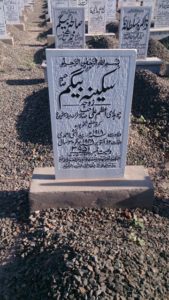
Father was about 78 when he last visited us in Rosebud, Missouri, USA. He stayed for 39 days. He had failing health. One morning he appeared even more week and low. We insisted and he told us that he had dreamt of my mother but could not recall if she had come to take him with her. My mother’s name Sakina is an Arabic word that means peace of mind and tranquility. Dreaming of her signified what her name meant. Father finally took his dream to have those plausible, positive and pleasant meanings. She was a Moosi who had bequeathed one-tenth of her estate for charity and is buried in Bahishti Maqbrah, Rabwah as shown in the following headstone.

TS -- Ammi Ji - Copy


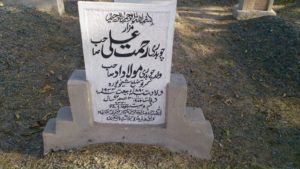
A couple of days later Father told us of another dream. Not his mother Mohammad Bibi but his father came and told him that he had come to take him with him.  My grandfather’s name Rehmat Ali in Arabic means the Blessings of the Highest. Dreaming of him is interpreted to mean receiving God’s blessings. Father’s dream had clearly indicated that he had God’s blessings that would stay with him till his end. He was a Moosi and is buried in Bahishti Maqbrah, Rabwah as shown in the following headstone..

TS Daadaa Ji


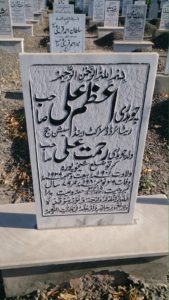
No one could say for sure whether he really cheered up or just wore that expression to save us the agony. But deep down we all knew that the end was near. Soon after returning to Pakistan, he passed away in Lahore. He was a Moosi and is buried in Bahishti Maqbrah, Rabwah as shown in the following headstone.

TS -- Abba Ji

In-na  lay  il-laa-hay  wa  in-na  alai  hay  raa-jay-oon       سُوۡرَةُ البَقَرَة  –  Ch: 002, Verse 157  We surely belong to Allah.  And we surely will return to Him.        002:157

  Kool-lo  nuf-sin  zaa-aiy-qa-ta  ul-mao-tay             سُوۡرَةُ آل عِمرَان   –  Ch: 003, Verse:186        Every person will taste death                           003:186 021:036 &  029:058


Dream of two daughters to be married with two brothers

Once Father dreamt that two of his daughters were married to two brothers and that was long before anyone was even engaged to be married.

Then in 1962, Father married his oldest daughter Rasheedah to Major Mansoor K Bajwa who was the younger brother of the wife of Brigadier M Iqbal. And at the same time, he married his next younger daughter Sajda with Riaz A Ghumman who was the younger brother of the same Brigadier M Iqbal. One being the younger brother of husband and the other being the younger brother of wife, it was thought that the dream was fulfilled.

But then in 1966 Father married his third daughter Qanta with Dr Ahsan U Zafar. Four years later in 1970, Dr Zafar’s younger brother Sami U Zafar returned from England with a master’s degree in law and was married to Father’s fourth and youngest daughter Khalda. That was the  real fulfillment of Father’s dream of his two daughters being married to two brothers.

All aforesaid marriages have lasted over one-half of a century and all four of my sisters  have lived to become grandmothers. The eldest two have even become great-grandmothers many times.

His dreams revealed the truth

Personally, all my life I feared that no matter what, when and where an objectionable, bad or poor thing I did, the Almighty God while even hiding it from the whole wide world would still let my father know of it. Deep down in my heart I knew that Abba Ji was constantly seeing the true dreams about me and others he loved, continuously praying to the Almighty God to forgive us and keep our wrongs unexposed and was being obliged by God Almighty’s special grace on him to keep away the ill consequences of our human follies.

All my siblings, all in our family, all friends knew of thousands of Father’s dreams he had seen about them. Whenever he saw a dream regarding friends or things happening around, he told about it and his interpretation of it. He warned all of us of the impending dangers and gave the news of good things that lay ahead. Everyone who knew Father requested him for prayers and later asked if he had a dream and his interpretation of it. We took clues to run our days accordingly.

Regarding the marriages of all his children, Father did the Istikhara, the special prayer seeking God’s guidance and approval about what a person thinks is best. Today over one-half century later to the last such marriage, I can say for sure that all these seven marriages were successful — by any known measure of remarkable spirituality, no-divorce, no-separation, happy in-laws, procreation, and raising highly educated, well-to-do and successful families of their own.

It is impossible for me to accurately describe my feelings by going back in the memory lane to recall how true his dreams came out so consistently. But some letters from others who wrote about Father and which I received reflect that phenomenon as well.


Posted in Commands - Humanism, Commentary and Notes, One God with 99 names, Qor-aan's Translation - verse # | Tagged , , , , | Leave a comment

Tr – Azam Ali, an Ahmadi Moslem – Ch 03 – Coach

Azam Ali, an Ahmadi Moslem

Chapter 03 – Coach

 Reap what you sow 

Abba Ji had a unique way of instructing – teaching, tutoring and training. He used to ask lots of questions, all sorts of questions, of us brothers and sisters, while we were growing up, even when we were grown up.

I was quite young when walking out in the fields one day he pointed to a standing crop. He explained that some farmer had ploughed the land and sowed the seed (paddy) for rice. He would watch it for months, look after it as much as he could, and then would harvest it.

Then he asked, “What will be the crop if the seed was wheat?”

After my answer, he asked, “Can the seed of rice grow the crop of wheat?”

After my answer, he asked, “Can the seed of wheat grow the crop of rice?”

After all that and back home, I shared my ‘discovery’ with my siblings who except my older half-sister were younger than me. No wonder a kid through such a drill cannot easily forget that You Reap What You Sow.

Abba Ji lived the life of a Moslem. Out of the home he was a lawyer and a judge who stated things very clearly and succinctly. Inside the home he was a father as well who guided and determined the future of at one time ten children of whom seven grew up to be grandparents.

His walks and talks reflected all the values and virtues that he believed, professed and practiced.  His conversations referred abundantly to his village life where he grew up and to his family roots.  He stated his personal experiences endowed richly with rainbow colors of wisdom and knowledge.  He interspersed his talk and life experiences with such frequent repetitions that we all knew them.  He followed the same regime asking questions at home with kids and outside with whoso he dealt.  He impressed his audience by telling stories and elaborating results from which they learnt easily.  He taught everyone who came close to him and all my life I watched him how he made his point.  He started invariably by outlining his plan and making every effort to accomplish what his plan was.  He repeated his pinpointed goal and kept asking questions so that his listener in effect learnt twice.  He asked his addressee about his goal and helped him to zero in on a way to reach those goals.  He swiftly moved to the implementation stage after he had guided the forming of the desired goal.  He repeated the same process in every situation and his listener learnt lessons without being taught.

Encouraged Effort

Sometime in 1948 he had a refugee visitor who complained of joblessness due to the Indo-Pak Partition. After his usual discussion of fixing a goal and selecting a road to reach it he called me, then his 12-year-old son. He introduced me to the visitor and asked me to recite a poem which at that time was a favorite of Father and me. Now I don’t remember the whole Urdu poem but recall the lines with which each verse ended as follows.                               Ooth baand kamar keya darta hai      i.e.       Get up. Be ready. What is there to fear.              Phir daikh khuda kiya karta hai.        i.e.       Then see how God makes thing appear.        The visitor acted upon the plan, found a job he was happy to do, and became a life-long friend.

Teaching children

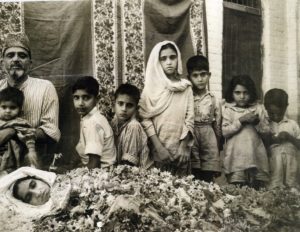
In October 1948 my mother passed away. Then on our father had also to be the mother of us all seven from 1-year-old to 13-years-old children (See Tr – Azam Ali, an Ahmadi Moslem, Ch – 11 – Knowledge)

1948 Oct 12 Sakina Begum with familyAbba Ji had lined up all seven of us (Khalida in his lap, me Abid, Hamid, Sajda, Majid, Qanta and Sadiq) beside our mother Sakina Begum who passed away on October 12, 1948, in Campbellpore.

Father intended to make us his kids physically strong, spiritually sound and morally solid.  All his input was focused on producing those results.  He used to pick one of the daily activities.  Then he microscopically examined and thoroughly explained numerous aspects of that activity.  Then he told of a story of someone who resolved to excel in that activity and had reached its top.  Then he talked of an appropriate prayer that had or could have helped him in reaching that goal.  Then he discussed additional benefits of that prayer and improvements in other fields as well.  He used to tell us of the prayer first and then instructed us to repeat it after him word by word. He passed us through these introductory stages just like a classroom discipline and atmosphere. He urged us to memorize each prayer, write it down if necessary and start using it continually.  He recited those words in the daily prayers, often loud for us to hear him and correct ourselves. He intended all those prayers to settle down deep in our minds and take roots for permanent use. He gathered us all children almost daily in a classroom scenario and asked us about the prayers.    Those who failed to give the right answers suffered the effect of the cause of failing homework.

Father’s ways were that I followed since most children do what they see their parents do.  He continually led us to memorize, internalize and utilize the prayers. The process to learn them at that time was easy as all it required was to narrate them if asked to. Over eighty years later now I am amazed at the lasting nature of his input and things he taught us. I still remember some of the occasions when we were taught or tested for a prayer or lesson. I need no effort in recalling a prayer which is most suitable for any good or sad occasion I face.

Our oldest sister’s son Dr Zarar Bajwa has often remarked: “The prayers Nana Abu (maternal grandfather) taught us after the Fajr (the morning) prayers when he visited us are hard to forget.” That is how Abba Ji is remembered by those of his third generation who had the good fortune to have benefitted by his love while also teaching, training and tutoring them imperceptibly.

Coach

Abba Ji was my guide and mentor. What I saw him do was that I subconsciously learnt to do as well. His way of forming an intent, setting up a plan, and right away start implementing the plan I copied. His ways of logic, reasoning and presentation I emulated in my talks, speeches and argumentation. His instructive teaching style in my speeches, advocacy and delivery of messages benefitted me well.

The onlookers in the fields of law and religion told me all my life that hearing and seeing me render some service, deliver a sermon in a mosque, or argue a case in a Court room made them feel as if they were hearing my father. I laid emphasis and fluctuated my tones in public speeches like that of my father. Even when I took a position that would have been 180 degrees opposite his way or view, my manner and method of expressing myself was that of Abba Ji. After all, Every Action Has An Opposite Reaction must also come into play sometime.

In 1959-60, Mr. Justice Orthicon heard me argue before him my first case ever in Lahore High Court. After I had left his court room, he openly made some complimentary remarks about my argumentation. Present in the court room was Chaudhry Mohammed Anwar Buttar Advocate who pointed out to the Judge that I was his colleague Chaudhry Azam Ali’ son.  “How unlike his father!” the Judge remarked. Apparently, he knew my father well and had high regards for his services in the Judiciary. He was happy to know that I was his colleague’s son who did the job well in his court. What the Judge appreciated was my presentation of the facts and preparation for my case even as I impugned the judgment of a lower court like that of my father.

Father is not with us today, but those prayers are and will benefit us forever. The prayers were an immensely rich treasure he laboriously instilled in us, and we conveniently accumulated.

Father in the spring of 1957 was in Montgomery, later called Sahiwal. He was there as the District and Sessions Judge to try a couple of murder trials and stay at the Government Rest House. I had come from the law school boarding house to stay with him for 2 weeks to prepare for my finals by pulling myself away from other activities.

One evening when returning from the mosque after the Mughrib (early evening) prayers we were walking together when in a rare show of emotion and affection he suddenly held my upper left arm and started, “Son, soon you will be a full-fledged lawyer and take the lead of your pack (meaning my siblings) from us older people.”

He talked for the next several minutes. I don’t recall what he said since I was lost in a rare outburst of his emotions which sort of lifted me up to cloud 9. Until suddenly I was shaken awake as if from a trance with the loud clicks of heavy boots of the Police Guard who came to the position of Attention to greet Father’s return to the Rest House.

Today I can’t recall what specific prayer he had discussed on that occasion.  But thinking back on our walk I am almost sure that he wanted me to understand the real impact of the prayer which Abraham had offered for his progeny, parents and people around him.

Rub-bay  ij-ul  nee  mo-qee-ma  us-sa-laa-tay  wa  min  zoor-ree-ya  tee                                 Rub-ba  naa  wa  ta-qub-bul  do-aa-aa                                                                                               Rub-ba  naugh-fir  lee  wa  lay  waa-lay-duy  ya                                                                             Wa  lay  il-mo-may-ne-na  yao-ma  ya-qoo-mo  ol-hay-saab.                                                                                                                        سُوۡرَةُ إبراهیم    –   Ch: 014, Verse 041 & 042       

           God, please make me and my progeny regular in prayers.                                           God of us all, please accept (this) prayer.                                                                           God of us all, please forgive me, my parents                                                                     And the believers the day Accounting takes place.    014:041 & 014:042

Tough act

Abba Ji, his parents, and parents of our mother prayed for us all the time. I think all parents do that. But our parents also established in us the belief that we were the conduits who must pass their prayers on to our next generation, and further had the duty to inculcate in them the determination to be the conduits to pass on to their children, and that the process must go on and on.

Today as a grandparent myself I wish I could pass even a millionth of the quantity or quality of those prayers or their results for my successors who nevertheless have a tremendous treasure of prayers coming down in pike to them from their ancestors.


Posted in Commands - Humanism, Commentary and Notes, One God with 99 names, Qor-aan's Translation - verse # | Tagged , , , , | Leave a comment

003:201

The Holy Qor-aan                                                                                                              003:201


يٰۤـاَيُّهَا الَّذِيۡنَ اٰمَنُوا اصۡبِرُوۡا وَصَابِرُوۡا وَرَابِطُوۡا وَاتَّقُوا اللّٰهَ لَعَلَّكُمۡ تُفۡلِحُوۡنَ‏


Yaa-auy-hul-la-zee-na-aa-ma-noos-bay-roo                                                                                    Wa-saa-bay-roo-wa-raa-bay-too                                                                                                        Wut-ta-qool-laa-ha-la-ul-la-koom-toof-lay-hoo-n


Listen you all who have believed! be patient                                                                      And persevere and stay ready                                                                                            And love Allah so that you can prosper.  


The Holy Qor-aan has used the Phrase Yaa-auy-yo-hul-la-zee-na-aa-ma-noo many times

  • يٰۤ — Yaa — Listen (= Be attentive; hearken; pay attention; O!)
  • اَيُّهَا — Auy-yo-ha(ul) — You all (= All addressees; entire audience; whole lot of listeners)
  • ٱلَّذِينَ — Ul-la-zee-na — Those who (= pl., m, 3rd person. Those articles, things or persons
  • اٰمَنُوۡۤ — Aa-ma-noo — They Believed (= v., past., pl., 3rd person. Believed in the Holy Qor-aan; became Moslems. Accepted, acknowledged, admitted or witnessed their entry in Iss-laam. See Commentaries like Islam – 101Phrase Aa-ma-noo-wa-aa-may-loos … and Believe and Disbelieve that floodlight other aspects how the Holy Qor-aan has used this word)
  • اصۡبِرُوۡا — (U)s-bay-roo — Be patient (= v., pres., pl., 2nd person. Be patient and steadfast. Be consistent, constant, continuing, determined, perseverant, persistent, pursuant and unwavering. Be repetitive without failing, falling, flailing, faltering or fouling. Endure. Show endurance and fortitude)
  • وَ — Wa — And (= Conj., links words, phrases or clauses; additionally; but also; more over; though; when; while; yet; whereupon)
  • صَابِرُوۡا — Saa-bay-roo — Persevere (= v., pres., pl., 2nd person. Excel and surpass all others in being consistent, constant, determined. Outperform. Persist. Be pursuant and steadfast. Show all above characteristics included in the meanings of اصۡبِرُوۡا.  A/t/a, ‘be more patient (than your enemy),’  ‘strive to excel in steadfastness,’  ‘Persevere … in constancy,’  ‘let your patience never be exhausted,’  ‘strive in patience,’  ‘strive to excel (the disbelievers) in being patiently persevering,’  ‘excel in steadfast,’  ‘outdo all others in endurance’ and ‘strive to excel in steadfastness’)
  • وَ — Wa — And (= Conj., links words, phrases or clauses. See وَ  above)
  • رَابِطُوۡا — Raa-bay-too — Stay ready (= v., pres., pl., 2nd person. Stay connected with and ready for (1) tying down horses or camels before coming into houses, (2) keeping horses or camels ready to go to war at a moment’s notice, (3) keeping outposts of your habitats combat-ready and (4) preparing for prayers ahead of their scheduled timings. Adopt protective measures. Be on guard. Be ready. Prepare. A/t/a, ‘guard your territory by stationing army units permanently at  places from where the enemy can attack you,’  ‘Strengthen each other,’  ‘Stand firm,’  ‘be steadfast,’  ‘guard (the frontiers),’  ‘be ready,’ ‘be on guard’ and ‘be on your guard’)

The rule in the next seven (7) words is repeated in                                                                                 verses 002:190, 003:131 and 003:201, etc.

  • وَ — Wa … (ut) — And (= Conj., links words, phrases or clauses.  See وَ   above)

The Holy Qor-aan has used the Phrase Wut-ta-qool-laa-ha … in many contexts

  • اتَّقُوا — Ta-qoo … (la) — You love (= v., pres., m., 2nd person, Act piously and avoid angering Allah by being deeply in love with Him; be afraid, pious  or righteous. See Commentary The Righteous) A/t/a, ‘be mindful’, ‘ward off evil and keep duty to Allah’, ‘fear Allah’ and ‘keep your duty’)
  • ٱللَّهَ — Laa-ha — Allah (= The Almighty God; The only One worthy of worship)

The result stated in next three (3) words is in verses 003:201005:036, 005:091,  005:101, 062:011, etc.

  • لَعَلَّ — La-ul-la — So that (= Haply; hopefully; perchance; perhaps; possibly; maybe; wanting and wishing the result to be)
  • كُمۡ — Koom — You (= pro., pl., m., 2nd person., You. The Holy Qor-aan has addressed men and women jointly this way)
  • تُفۡلِحُوۡنَ — Toof-lay-hoo-n — Prosper (= v., pres., pl., 2nd person. Be victorious; grow; succeed; triumph; win)
Posted in Commands - Humanism, Commentary and Notes, One God with 99 names, Qor-aan's Translation - verse # | Tagged , , , , , | Leave a comment

003:200

The Holy Qor-aan                                                                                                                003:200


 وَاِنَّ مِنۡ اَهۡلِ الۡكِتٰبِ لَمَنۡ يُّؤۡمِنُ بِاللّٰهِ وَمَاۤ اُنۡزِلَ اِلَيۡكُمۡ وَمَاۤ اُنۡزِلَ اِلَيۡهِمۡ خٰشِعِيۡنَ لِلّٰهِ ۙ لَا يَشۡتَرُوۡنَ بِاٰيٰتِ اللّٰهِ ثَمَنًا قَلِيۡلًا ‌ؕ اُولٰٓٮِٕكَ لَهُمۡ اَجۡرُهُمۡ عِنۡدَ رَبِّهِم ‌ؕ اِنَّ اللّٰهَ سَرِيۡعُ الۡحِسَابِ‏


Wa  in-na  min  auh-lil-kay-taa-bay                                                                                                    La  mun-yoe-may-no  bay  il-laa-hay                                                                                           Wa  maa  oon-zay-la  elai  koom  wa  maa  oon-zay-la  elai  him                                               Khaa-shay-ee-na  lay  il-laa-hay                                                                                                         Laa-yaush-ta-roo-na  bay  aa-yaa-tay  il-laa-hay  tha-ma-nun  qa-lee-laa                            Olaa-aiy-ka  la  hoom  uj-ro  hoom  in-da  rub-bay  him                                                                In-na  ul-laa-ha  sa-ree-o  ol-hay-saa-b


And really among the people of the Book are those                                                        Who surely believe in Allah,                                                                                                  And all that is entrusted to you and all that is entrusted to them                          Humbling down to Allah.                                                                                                    They do not sell the signs of Allah for a paltry price.                                                    All these are for whom there is a reward with their God.                                            Allah certainly is very swift in reckoning. 


  • وَ — Wa — And (= Conj., links words, phrases or clauses; additionally; but also; more over; though; when; while; yet; whereupon)
  • اِنَّ — In-na — Really (= Absolutely; definitely; doubtlessly; certainly; earnestly; indeed; positively; really; seriously; surely; truly; verily. A/t/a, ‘Lo’)
  • مِنۡ — Min — Among (= Among, from or out of the class or category or several articles, counts, kind, things, persons or phenomenon)
  • اَهۡلِ — Auh-lay … (il) — People of (= Believers in and users of; citizens; dwellers; families; folks; household; inhabitants; live-ins; masters; owners natives; occupants; people; populace; population; those belonging to; those entrusted to)
  • الۡكِتٰبِ — Ul-kay-taa-bay — The Book (= n., 1. The Divine Directive of Commands, Prohibitions, Rules and Regulations. Holy Scripture. Perfect Book Testament that holds good and is operative eternally. Decreed part of a religion. Spiritual Code codifying the rules of universal application.  2. The Collection of mandated, ordered, prescribed, preserved, recorded,  written Do’s and Don’ts.  3. Authentic penned down material in black and white)
  • لَ — La — Surely (= Absolutely; definitely; doubtlessly; certainly; earnestly; indeed; positively; really; seriously; truly; verily)
  • مَنۡ — Mun — Who (= Anyone; whoever; whom; whomever; whoso)
  • يُّؤۡمِنُ — Yoe-may-no — They believe (= v., pres., s., Follow the Holy Qor-aan, enter the Faith, embrace Islaam and become Moslems)
  • بِ — Bay … (il) — With (= Literally the word  بِ  means ‘with’)
  • اللّٰهِ — Laa-hay — Allah (= The One and the Only One Almighty God)
  • وَ — Wa — And (= Conj., links words, phrases or clauses. See وَ  above)
  • مَاۤ  — Maa –All that (= What; whatever; whatsoever; when; whenever)
  • اُنۡزِلَ —  Oon-zay-la — Entrusted (= v., past., pass., s, 3rd person. Dispatched; was given; granted; inspired; revealed. Handed, laid, lowered, or sent down. Also, delivered; landed; provided; released; supplied. See Note 002:005a. A/t/a, ‘In the revelation’ which is a noun although the Holy Qor-aan has used the word which is a verb in the passive form and in the past tense)
  • اِلَيۡ —  Elai — To (= In the direction of; to; towards)
  • كُمۡ — Koom — You (= pro., pl., m., 2nd person., You. all men. The Holy Qor-aan                 addresses men and women jointly this way generally)
  • وَ —  Wa — And (= Conj., links words, phrases or clauses. See وَ  above)
  • مَاۤ — Maa — All that (= What; whatever; whatsoever; when; whenever)
  • اُنۡزِلَ — Oon-zay-la — Entrusted (= v., past., pass., s., 3rd person. Dispatched, given, granted, inspired, revealed or sent down. See  اُنۡزِلَ  above)
  • اِلَيۡ —  Eai — To (= In the direction of; to; towards)
  • هِمۡ — Him — Them (= pro., pl., m., 3 rd person. Refers to aforesaid believers)
  • خٰشِعِيۡنَ — Kha-shay-ee-na — Humbling (= v., pres., pl., 3rd person. Afraid to anger Allah; devout; fearing; humble-minded; obeying Allah submissively; standing in awe of; God-fearing. A/t/a, ‘Bowing in humility’)
  • لِلۡ — Lay … (il) — To (= Concerning, regarding; relative to; to; towards. A/t/a, ‘before’)
  • اللّٰهِ –Laa-hay — Allah (= The One and the Only One Almighty God)
  • لَا — Laa — Do not (= Naught; neither; never; none; nor; not at all; absolute
  • يَشۡتَرُوۡنَ‏ — Yaush-ta-roo-na — Sell (= v., pres., pl., 3rd person. Acquire by paying price; barter; buy; choose; purchase; sell; trade. A/t/a, the translations like ‘they have purchased’ and ‘taken in exchange for it’ in the past tense are inaccurate because the Holy Qor-aan has stated this action with a verb in the present tense clearly indicating it as a Rule of Universal Application that whoever at any time in future will do a thing like it will be entering a bad deal)
  • بِ — Bay — With (= Literally the word  بِ  means ‘with’)
  • اٰيٰتِ — Aaa-yaat … (il) — Signs (= n., pl., 1. Manifestation; message; narrative; revelation; verse. 2. Command; direction; evidence; law; order. 3. Corroboration; indication; lesson; portent; proof; pointer; symbol; token. 4. Any element that creates a very clear picture and leads to an absolute certainty. 5. Argument, part, portion or testimonial of Truth  about God)
  • اللّٰهِ — Laa-hay — Allah (= The One and the Only One Almighty God)
  • ثَمَنًا — Tha-ma-nun — Price (= n., Consideration paid and accepted in an exchange for an article bought or sold; end; gain; profit; sum; value)
  • قَلِيۡلًا — Qua-lee-lun — Paltry (= Adj., A bit; a few; a short while in time; comparatively  insignificant; less, little, small or tiny in number, quality or quantity; miserably low; meager; paltry; meager; trifling. Also, little in quality or quantity; short while in time)
  • اُولٰٓٮِٕكَ — Olaa-aiy-ka      All of these     (= Acts; facts, items, persons or things. A/t/a, ‘It is these’ and ‘These it is’)
  • لَ — La — For (= For the object, purpose or reason of; intended for; regarding; relative to. Also, belonging to; to; towards)
  • هُمۡ‌ — Hoom — Them  (= pro., pl., m., 3 rd person. Refers to aforesaid believers)
  • اَجۡرُ — Uj-ro — Reward (= n., pl. Awards; consequences; good results; prizes; recognitions; trophies)
  • هُمۡ‌ — Hoom — Their (= pro., pl., m., 3 rd person. Refers to aforesaid believers)
  • عِنۡدَ– In-da — From (= At; close at hand; from; in; in close proximity of; with; in  counting, esteem; estimate, eyes, front or near. Within the presence, precincts, seeing or sight of)
  • رَبِّ — Rub-bay — GOD / LORD (= The Almighty Allah who fills all needs of all creatures. Cherisher. Creator. Guardian. Lord Provident. Master. The Only One Who provides all that sustains life. Ultimate Provider of air, water, food and whatever we and all other creatures need to live and subsist)
  • هِمۡ — Him — Them (= pro., pl., m., 3 rd person. Refers to aforesaid believers)

The construction of the next four (4) words is also in 003:200 and 005:005.

  • اِنَّ — In-na … (ul) — Certainly (= Absolutely; definitely; doubtlessly; earnestly; indeed;      positively; really; seriously; surely; truly; verily)
  • اللّٰهَ — Laa-ha — Allah (= The One and the Only One Almighty God)
  • سَرِيۡعُ‏ — Sa-ree-oo … (l) — Swift (= Hurried; In an expedited manner; promptly; quick)
  • الۡحِسَابِ — Hay-saa-b — Reckoning (= n., Accounting; adjusting credit and debits;  balancing; calling to count; finalizing the gives and the takes; take account. A/t/a, ‘settling account’)
Posted in Commands - Humanism, One God with 99 names, Qor-aan's Translation - verse # | Tagged , , , , , , | Leave a comment