Azam Ali, an Ahmadi Moslem
Dad seen by daughter
by
Sajida Riaz Ahmad
Assisted by and titles by
Azra Abid Buttar
Urdu version of a part of the article was published in Un-Noor, USA of May-June 2016.
http://www.ahmadiyyagazette.us/Source/2016/May-Jun/May_Jun2016-UrduSection.pdf
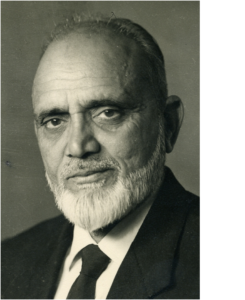
Ancestors
My father Mokarrum Chaudhry Azam Ali was born in 1902 to Mokarrum Chaudhry Rehmat Ali Sahib in the village Kirto of District Sheikhupurah. Originally called Kartarporah the village is around fifty miles in northwest of Lahore. Later it became known as Kirto. The Satellite view of the village now shows it written as Kirto Sharif.
At one time the lands around the village belonged to our 7th great-grandfather Kartar Singh. He had defeated a royal wrestler at the time the Moguls ruled India. He was awarded the prize to ride his buffalo and own all the land that the buffalo covered in one day. That is how he came to own seven villages. The site he settled on got named after him as Kartarporah and the twin-villages were called Kirto-Pandori because his brother Pandora Singh also lived there
Our grandfather Chaudhry Rehmat Ali was a Shiite who had an Imam Bara, owned horses and practiced congregational mourning and other rituals with total dedication. Our grandmother passed away when our father was about 20 years old. The mother of our father and the mother of Sir Zafrullah Khan who later became a Judge in the International Court of Justice at the Hague were cousins being the daughters of two sisters.
Abba received his primary education in the village, attended high school in Gujranwala, and graduated from the Deyal Singh College, Lahore. A merit-based scholarship enabled him to continue studies further. He obtained an LL.B. degree from Law College Lahore and later passed the PCS (Punjab Civil Service) examination.
Entry into Ahmadiyyat
Abba Ji did not like some Shiite rituals. He studied religious materials on his own. By grace of God he came across Ahmadiyya literature and read it. The more he read it the more he was drawn towards Ahmadiyyat. He prayed to the Almighty God to show him the right road. He reached an absolute conviction and became Ahmadi in1930. He devoted his life to serve the Ahmadiyyat. He bequeathed one-third in Wasiyyut (dedication of one’s assets for the service of the Ahmadiyyat).
Our grandfather vehemently opposed our father’s becoming an Ahmadi and even disentitled him from all inheritance. The discontinuation of funding for a student can become a problem but the Almighty God always takes care of His beloved people.
Abba Ji took seriously his duty to spread the message of real Islam, the Ahmadiyyat. He explained things well to his relatives and others in the village where his father and brothers had once led the opposition. By the grace of God and the prayers of the Khalifa-tool-Massih (razi-Allaho-unho), his continued efforts with wise ways [per the Holy Qor-aan 016:126] started producing positive changes. Eventually his father embraced Ahmadiyyyat. Gradually many others in the village followed him and became Ahmadi.
Page 1
Words of the Khalifa-tool-Massih II (razi-Allaho-unho)
His devotional growth was certified by the glorious tribute that the Khalifa-tool-Massih II (razi-Allaho-unho) paid in his Annual Conference Speech in 1933. I reproduce an extract about two persons who coincidently later became related as the father-in-law and son-in-law.
“By the Grace of God a new spirit is growing in Punjab. It seemed practically dead for a time but a new growth is in the offing for the last two years. By the Grace of God young men with quality and devotion are coming forward.
“Today I will mention the names of some of them. This conforms to the tradition set by the Promised Messiah (Aalai-hissalaam) who used to announce the names of some devotees. Taking the names this way generates in them a self-esteem to keep their names good. There is also a need to name some devout young men in order to highlight their efforts and accentuate their abilities to work.
“One of them is Chaudhry Faqir Mohammed Sahib who has been Ahmadi for some time and is an excellent example for young men.
Another is Chaudhry Azam Ali Sahib who recently became an Ahmadi. He has shown an exemplary sincerity. He came from the Shiites but in a very short time has produced an excellent example of devotion. I see no reason why new entrants in the Community should not emulate him in making progress in the matters of their religion. Six months after his Bai-ut (initiation in the Community) when I saw him I could not recognize him because his facial expression showed a piety as if he had been an Ahmadi for a long time.” [History of Ahmadiyyat, Vol 6, pp 132, 133]
Testimony of a fellow devout
Such extraordinary appreciation must surely have been preceded by untiring hard work in spreading the word. We have no saved record of those feats but one can imagine that from a writing of Mokarrum Mian Abdur Raheem Deyanut Durwaish (a devotee who voluntarily stayed behind to protect the Ahmadi town of) Qadian who wrote as follows.
“This happened in Makarian,. Chaudhry Azam Ali Judge came there on a Waqf-e-Aarzi (Voluntarily but temporarily undertaken obligation earmarked to spread the word of God).
One day in his own unique way he stopped a Moslem on the road and extended the ‘Call to God.’ While talking he said that the religious scholars of our time have not acted honestly. So much so that even the wolf who (was accused that it) ate Hudzrut Joseph (peace on him) said to Hudzrut Jacob (peace on him) that “If I ate Joseph, may I resurrect as a 14th Century scholar.”
Page 2
“The addressee demanded to know where it was written. Chaudhry Sahib brought him home. He looked in the book and found that excerpt missing. Chaudhry Sahib did not know that religious scholars did such a thing and mutilated books by deleting the entire episodes from there.
“Chaudhry Sahib was a simple man, very sincere. I saw blisters on his feet from long walks but he never missed a day of preaching. We benefitted a great deal from Chaudhry Sahib’s personal grandeur and righteousness demeaners. People came to him for consultations.
I had developed an expertise in cooking. Chaudhry Sahib utilized that to invite high officials and people in the upper echelon. That provided an opportunity to start conversation and a facilitated our living a better life in the area. The Almighty God does indeed put His people to good use. May God reward him with the best possible rewards; Amen [The Living Tree by Amatul Bari Nasir, p 135]
Marriages
Chaudhry Azam Ali was still studying in the Law College when according to the custom and Elders’ decision he was married to Mokuramah Amina Begum, daughter of Chaudhry Sultan Ahmad, Bar at Law. She was a sister of the famous poet Faiz Ahmad Faiz. We called her Amma Ji. Amma Ji was of a simple nature and highly religious bent of mind. She was determined to memorize the Holy Qor-aan. Her life revolved around that. Uninterested in worldly attractions she remained engrossed in praying all the time. She gave birth to two daughters and one son.
My father was a Sessions Judge who also served the Community in many notable positions. He was highly interested in preaching. It was necessary to have a life companion from an Ahmadi home and well-versed in religious affairs. At the suggestion of Khalifa-tool-Massih II (razi-Allaho-unho) my father got married for a second time to Mokuramah Sakina Begum Sahiba, daughter of Chaudhry Faqir Mohammad who was a Deputy Superintendent Police.
My mother’s age at the time of her marriage was thirteen-and-a-half years. She was a student in 7th grade and a class-fellow of Syyedah Maryam Siddiqah (razi-Allaho-unhaa) and Sahibzadi Amatur Rasheed Sahiba. Being of a tender age and being sent as a second wife, her mother had reservations to this marriage. But upon hearing that the move for the marriage had been initiated by the then-Khalifa, her father also conceded.
Relations with the family of the Promised Messiah, alaihissalaam.
My maternal grandfather’s house Faqir Manzil was located on Railway Road in Qadian. Our maternal grandmother was a simple strong-willed Jutti who kept two or three buffaloes at home and had always a lot of milk, yogurt and butter at hand. She often recalled how Hudzrut Amma Jan (razi-Allaho-unhaa) on her morning walks came to our home and had breakfast with us. My grandmother cooked delicious Parathas (a multi-layered pita-bread laced with butter in every layer and baked) which she happily served to Hudhrut Amma Jan (razi-Allaho-unhaa).
Page 3
We had close relationships of love and respect with the whole family of the Khalifa-tool-Massih II (razi-Allaho-unho), specially with the families of Doctor Mir Mohammad Ismaeel (razi-Allaho-unho) and Mian Muzaffar Ahmad.
At times Dr Mir Mohammad Ismaeel, Mian Muzaffar Ahmad, my maternal grandfather and my father as government officers were posted in the same city. That provided these Ahmadi devout ample opportunities to meet and enabled their families interact and admire each other.
Loss of our mother
Our mother was blessed by the Almighty God with four sons and three daughters. Born in 1919 and died in 1948, she had a very short life and spent only fifteen years with Abba Ji.
We lived in Campbellpore. My mother was Moosiyyah (a woman who had dedicated a part of her assets for the service of the Ahmadiyyat). Immediately transporting her body to Rabwah was difficult; so she was buried in Campbellpore in-trust. The following year she was brought to and laid rest in the Bahishti Maaqbarah in the grounds of Rabwah.
This writer at that time was a 10-year old and our youngest sister was 10-months old. My aunt who was the mother of Dr Ahsanullah Zafar, the Amir of the Ahmadiyya Community in USA, used to keep me with her. All us siblings remained very close to our maternal grandmother.
Character
A great responsibility had fallen on our father. Amma Ji despite being busy in memorizing the Holy Qor-aan and otherwise a very silent person was nevertheless the lady of the house. But even she died 12/13 years after my mother’s death. Then on my father was left alone for the uphill task of taking care of all 10 of his children. Some people suggested that Abba Ji marry again but he disagreed. Instead of pushing the kids into a turmoil, he sacrificed himself and passed a difficult life.
The job of a Sessions Judge was pretty difficult and time-consuming. But Abba Ji all alone with the God-given rare abilities fended for his children, provided the worldly and religious education, arranged their marriages and filled every heavy-duty responsibility in an unparalleled excellence for about 30 years
He was very keen on providing religious coaching.
He employed Haafiz to teach his children the Holy Qor-aan as experts in teaching that.
He taught the translation and extrapolation of the Holy Qor-aan himself.
He bought a copy for every one of his children when Tufseer-e-Sagheer was published
He heard from us children the prayers and theirs translations.
Page 4
He lead the prayers at home when he was there and conducted discussions afterwards.
He discussed some of his cases and shared conclusions how bad actions entail bad results.
He narrated incidents from the Islamic History in order to train us as hard core Moslems.
He fixed prizes for reading pages of books by the Promised Messiah (Alai-hissalam). He intended that way to develop in us children a taste to study those books.
He supplied solutions to our problems often in a question-answer format.
He took us to attend the Friday prayers along with him.
He regularly brought us to Rabwah to attend the Annual Conventions.
He bought six kanals of land in Rabwah and built a house on four kanals.
He wanted his children to get good education by living in the Center.
He prayed and prayed and worked hard to raise his children educated dedicated Ahmadi.
He got rewarded by the grace of Allah to have all his children grow up highly educated.
He shared his children successes including their rendering various services as Ahmadies.
He enjoyed his family’s pleasures and bore their tests and turmoil with patience.
Profession
Abba Ji served as a Judge who was a just jurist. After reaching his age of superannuation he practiced law in the Pakistan Supreme Court and Lahore High Court as a member of the High Court Bar Association. His soul was untiring and his mind never ceased working to the optimum.
During his service he probed deeply every case that came to his court. Difficult cases were entrusted to him when connections and money were suspected to illegally influence the outcome of a case and an iron-fisted fair and just adjudication was required. He received threats to his life and even actual attacks — but he never budged from the truth and justice.
Professional services to people he rendered as the worship of the Almighty God.
Prayers, persistence, honesty and hard work were his way of life.
Prior reputation as an unapproachable judge ran ahead of him wherever his was posted.
Practicing the culture of Ahmadiyyat diligently, he served it wherever he went.
Promotions in his 26/27 years service career elevated him to a District and Sessions Judge.
Posting as Session Judge in home district of Sheikhupurah made him a legend in honesty.
Public recognition of his excellent work resulted in a 3-year extension in his service tenure
Performing as a just judge led to his serving higher tribunals, like a Claims Commissioner.
Pension increase and Certificate of Appreciation he received at retirement.
His class-fellows, friends and apprentices included Judges and lawyers of great caliber. Justice Munir, Justice Kayani, Justice Sardar Iqbal, Justice Malik Abdul Hameed, Justice Samdani, Justice Shafi-ur-Rehman and many others vouched for his capabilities. Ahmadi Sessions Judges like Chadhry Bashir Ahmad, Chadhry Aziz Ahmad Bajwa and Mahr Sher Mohammad Sial were his friends who greatly admired and genuinely held him in a high esteem.
Page 5
In 1950, Justice Sharif Ahmad wrote that he could revolutionize the Pakistan Judiciary if he could find a few honest judges like Chaudhry Azam Ali. In 1985, Justice Samdani entrusted with an inquiry relative to Ahmadiyya Community went out of the way to seek the help from Abba Ji and Chaudhry Aziz Ahmad Bajwa because he personally knew that these two gentlemen would always side, support and stay with the truth.
Sacrifices
Only his passion for preaching exceeded his giving charity. He helped his villagers any way he could. He gave in all appeals for money but earned only by lawful means. He was a rare breed of just, honest and fair judges who remained far above the rampant opportunities of illicit gains that plagued Government Services. As a daughter I can vouch that he never touched even a single penny from any illegal conduct.
He donated in different charities on behalf of all his family members. He was a One-third Moosi (who bequeath part of their assets for the service of the Community). He enrolled his mother and all members of his family in the ‘First-Rank of 5000-Strivers of Tehrik-e-Jadeed’ and regularly contributed on their behalf as reflected in records as follows.
03697 Chaudhry Azam Ali
03703 Hamid Ali son of Chaudhry Azam Ali
03702 Imtiaz Ali son of Chaudhry Azam Ali
03701 Qunita Begum daughter of Chaudhry Azam Ali
3698A Mother of Chaudhry Azam Ali
03704 Majid Ali son of Chaudhry Azam Ali
03706 Mohammad Sadiq son of Chaudhry Azam Ali
03707 Abid Ali son of Chaudhry Azam Ali
03699 Rasheeda Begum daughter of Chaudhry Azam Ali
03700 Sajida Begum daughter of Chaudhry Azam Ali
03705 Sakina Begum wife of Chaudhry Azam Ali
He was a Devotee For Life who dedicated all his sons as the Devotees as well. His top priority was serving the Community. In his job he was transferred to big cities. Wherever he went, he contacted the Community promptly and was entrusted with rendering important services.
Preaching in a village
His interest in preaching exceeded all limits. He was a preacher at heart. Several times each month he went out to the nearby villages in simple dress and appearance. He knew Punjabi-speaking villagers’ response to the news of the arrival of the Messiah-Of-The-Time.
Some of those events left behind extraordinarily lasting memories. He was posted in Zeera which is a town in the Eastern Punjab. He chose to utilize a holiday for his usual preaching
Page 6
activity and decided to go out and deliver the message about his beloved, the Messiah.
Abba Ji reached a village at the time of severe heat of harvesting the wheat. He took a scythe, mixed with the laborers and started cutting crop and conveying the news of the arrival of Messiah.
Customarily a farmer sought his wheat out of the fields fast at harvesting time. Cutting crop under bright hot summer sun was not an easy task. Many laborers never returned to work on the day after they had received their wage. To ensure the labor’s return next day the farmers paid only after a crop had been fully harvested.
Abba Ji worked shoulder to shoulder with the laborers all day in the blistering heat. In the evening the laborers complained to their farmer: “This man has picked our brains all day. He talked of things above our heads. Please pay him his wage and send him away so that he doesn’t have to turn up next day.”
The farmer looked at the appearance of Abba Ji and said nothing. He tried paying him higher wage based upon his best performance of the day and to ensure his return next day, but Abba Ji got up, dusted off his clothes and walked away.
A policeman happened to pass by. In surprise he asked him, “Judge Sahib, what brought you here.” Abba Ji replied that he had come to fill his wish.
Calling all around is only our real task today.
The good natured will come after all one day.
[The Promised Messiah, peace on him]
The farmer came to know that the person from who took labor all day and fed like laborers was the Judge in Zeerah. So next day he came to our father’s Court to apologize. Abba Ji treated the farmer with great respect and assured him that he had done all that of his own free will.
Preaching in the villages
Whenever he visited his native village he went to the nearby villages. Villages have old feuds and murders. That is why fearlessly going in another’s territory was dangerous but he trusted his God, the Great Protector. Without fearing any danger he went on preaching. Besides enemy’s attacks, dangerous poisonous snakes were also common. The saline land is as much notorious for its poisonous snakes as it is famous for its Basmati rice.
Whenever he did not return home for two or three days his family members grew concerned. When our grandfather admonished him, he calmly replied that life and death were in the hands of God, “I am His man and the Almighty Allah Himself protects me.”
Page 7
Co-villagers of Abba Ji also made great progress in devotion. Our paternal uncles built a mosque. An Ahmadiyya library was also set up. When a ban was placed on Ahmadiyya ommunity from calling the Azan (for prayers), nobody dared to stop Azans from this mosque. The Khalifa-tool-Massih IV (ra-hay-mul-laaho-alaihay) mentioned this incident in one Friday sermon in appreciative tones.
Incident in the High Court Bar
In 1974 or 1975 Abba Ji was practicing in the High Court. He used to sit on a table in the Bar room. Chaudhry Aziz Ahmad Bajwa and uncle Chaudhry Abdullah Bajwa (father of Wajeeh Bajwa of USA) also took seat on that table. Once a placard written with the word Graveyard was put on their table. When these gentlemen ignored that, the opponents felt infuriated even more.
As Abba Ji got up to walk away, a young lawyer caught him by the throat while all around educated people just sat and stared. The young man was probably stricken by the fact that he was the nephew of a Justice. He screamed, “You are an Infidel. Recite the Kalima. Become a Moslem.” He also announced a reward if Abba Ji converted, “I will divorce my wife and along with my two sisters I will deliver them to you to do what you like.” [Perhaps he wanted to get rid of his wife anyway and did not want to incur the usual cost of a divorce!]
Abba Ji calmly said that he was a Moslem, recited the Kalima and added, “I am a better Moslem than you.” That man demanded to abuse Mirza Sahib. Abba Ji said, “The Holy Prophet (s.a.w) had prohibited cursing the leader of any religion. How can I abuse him whom I consider to be the Imam of our Time.”
That young lawyer roiling in anger continued threatening. Abba Ji had just one reply, “My life is in the hands of the Omnipotent Omnipresent, the Master who has never left me.” The well-wishers advised Abba Ji to seek legal recourse against that out and out transgressor but Abba Ji kept quiet and left the matter to God.
A funny anecdote followed. Those days I was visiting Abba Ji in Lahore. Mullahs in Daska had made our lives difficult. So my husband Riaz and our five daughters had come to Lahore. We were staying on Edwards Road in a flat above the office of my brother Abid Buttar who was an Advocate in the High Court. Abba Ji came and told us of the whole incident. Riaz in his usual manner and masterful ability to turn even the most sad or painful thing into a laughable joke commented that Abba Ji should have let those women come — and serve us as our servants. Abba Ji just kept asking for God’s Forgiveness and repeating ‘We belong to Allah and to Him we will return‘ [per The Holy Qor-aan 002:157].
The matter had not really ended there. Around midnight Abba Ji noticed some people jump over our gate and the outer wall. They were about fifty armed with daggers, knives and sticks. Riaz, I and our daughters sat by a window in a room upstairs. Abba Ji gave Riaz his pistol
Page 8
and told him to fire only if the raiders broke open the office door. Then he took his rifle, sat by the window in the office downstairs, called a cousin Irfan Ali and apprised him of the situation.
Behind our office in the Old Anarkali area were homes of some Hulwaaees, the merchants who sold sweets. They were also wrestlers. They held Abba Ji in high esteem, having had some cases in the High Court and guidance from Abba Ji that saved them time and money. They came out with sticks.
By then the Deputy Inspector General Police also arrived with four or five trucks loaded with policemen. Allah the Exalted thus foiled what the mischief-mongers had intended.
Visiting prisons
In 1975 Abba Ji came to USA to meet his son Dr Majid Ali and son-in-law Dr Ahsanullah Zafar. The children worked all day but Abba Ji could not sit idle. So he created a job for himself of his own liking.
He told my brother to drop him at a jail on his way to his work. Abba Ji had a life-long experience of officially inspecting jails. He knew that the prisoners had a lot of time and a state of mind that adheres to good advice; so why not to give them the message of Truth.
So my brother started to leave Abba Ji at the local prison gate. This dedication came to fruition. Some of the prisoners after coming out of the prisons became Ahmadi, came to Rabwah, sat before the then-Khaleefah and even attended the Annual Conference.
Which roads can I take to access the house You have.
What service can I render to reach my fate You have.
Interesting Stories
Abba Ji told us interesting stories. In Kirto a man came playing the role of a far-sighted saint came and held the hand of our grandfather to tell him his fortune. People sat around very impressed but our grandfather knew such imposters well. Our grandfather struck him a couple of times and said, “Maulvi, you could not see your own future that you were about to get a shoe-beating here. What could you tell me of my future.”
Sir Zafrullah Khan was a Judge in the International Court of Justice at the Hague. He was an older cousin of Abba Ji who a few years later became a fellow-lawyer and good friends. One winter he came to Pakistan for the annual Convention that enabled the two to visit with each other. Muffled in warm long overcoats they walked together for a while. They tried to keep their hands inside the pockets of their long coats. They thought they were fighting the cold by clinging to each other when Sir Zafrullah Khan asked Abba Ji to walk a bit of distance between them.
Page 9
Abba Ji said that he would like to put more distance in-between but there was a difficulty. Surprised he asked about the difficulty. Abba Ji said, “Your hand is in my pocket.” He pulled his hand out and the two had a good laugh.
In Rabwah Abba Ji used to go out to the nearby villages for preaching with a few friends like Chaudhry Fateh Mohammad Sial, Chaudhry Mohammad Hussain and Dr Ghulam Mustafa. Once they planned to walk towards Ahmad Nagar next morning. Early morning they knocked at the door of Chaudhry Fateh Mohammad Sial who hurriedly dressed himself and came out. After walking a while he realized that the Salwar (pant) he had put on was made of Satin, belonged to his wife and was too short on his long legs.
In Multan Abba Ji was posted 1949 or 1950. An influential army colonel of Montgomery / Sahiwal had some poor persons’ hutments torched in order to take possession of the land underneath. Some deaths ensued. The local judges felt uneasy to entertain the murder trial as it drew close. The case was eventually assigned to Abba Ji’s court who traveled to Montgomery and conducted the trial. The case concluded convicting all criminals – death sentence to the gang-leader colonel, life sentence to his brother and other terms to remaing four or five accomplices. The colonel on hearing the sentences threatened that – as the death of a jackal drives it to a human village – my father’s death had brought him to their town to try their case. Abba Ji prayed a lot since the motivation to hurt him was great due to the outcome of the case, his daughters attending schools and colleges and the ever-present danger on his being an Ahmadi. As always the Almighty Allah took care of him. The government posted police guards and the colonel’s gang could not harm us.
In Dera Ghazi Khan Abba Ji was the District and Session Judge. A crowd raising slogans came to raid our house. The crowd pushed ahead of it two dogs on leashes with placards around their necks, one with the name of Abba Ji and the other with that of Sir Zafrullah Khan. They were letting out their meanness by striking the dogs and abusing the notable Ahmadies. Help from the Almighty God came fast. The next door residence was of the Deputy Commissioner who had been impressed with Abba Ji’s simple lifestyle and the judicial acumen. He summoned the police who ran the crowd off before they could inflict any harm on us.
Hajj, the Pilgrimage
Abba Ji had been fortunate to perform Omrah twice. But his desire to perform the Hajj had not been filled. In 1969 he developed a great desire to do Hajj. The procedure to go for Hajj from Pakistan entailed applying many months before the Hajj, drawing of lots, and then being allowed to travel if the name had come out in the lots. Abba Ji had neither applied for the Hajj nor had the needed money but he had the desire and he prayed earnestly. In a dream he saw the Khalifa-tool-Massih I (razi-Allaho-unho) give him the good news of the Hajj although it appeared unlikely that he could go since very little time was left.
Page 10
One day a letter from my brother Dr Majid Ali in USA arrived with the details of a paid ticket and hotel bookings. Abba Ji came to us in Karachi with the ticket. We were worried that even if he could go, how would he, in weak health and used to simple ways, be able coup with the journey and live and eat in hotels.
His staying for the Hajj for the shortest possible time was deemed best. My older sister’s brother-in-law is Kanwar Idrees, CSP who also served as Pakistan’s Finance Minister. He arranged for Abba Ji such seats that he could go on the last flight before the Hajj and return by the first flight after the Hujj.
A Hajji then was allowed to take only 20 Rupees. Abba Ji took 20 Rupees and his entire luggage was his 2 pairs of clothing, one sheet and one blanket. In fact to enable him to travel light I kept his blanket so that he could buy a better one in Madina.
My husband Riaz Ghumman and I took him to the Karachi Airport to see him off. We felt concerned on his travelling alone but were fortunately allowed to accompany him to the lounge and then to the plane. We seated him, tied his safety belt around him, and stayed with him until the plane got ready to fly. We saw Almighty God Himself make all arrangements for Abba Ji.
Two and one-half hours later he arrived in Jeddah. He gave the 20 rupees he had to the porter who carried his luggage and led him to his hotel. It was a night time, strange city, and he was hungry with no money. He went up the stairs in his hotel, sat down in a corner and covered himself under his sheet.
Then some people came in. One of them appeared to be their leader. They entered in a room across from where Abba Ji was sitting but soon all left except the leader. Abba Ji heard loud painful groans from the room and entered it to check. He saw the man suffering from some severe headache bout. Abba Ji pressed his head, prayed for him and ended his prayer with a dum (the seal that the marks the end of a prayer). The man soon recovered, spoke in some other language, motioned Abba Ji to stay in his room, and even sent for food for him.
In the morning the man with whom my brother had made all arrangements arrived. He took Abba Ji to the bank and had him checked-in the hotel. Abba Ji was about to sit for breakfast when he noticed the aforesaid leader sitting on the next table. The man saw Abba Ji and invited him to his table. He saw in Abba Ji’s hand his copy of the Holy Qor-aan and in English asked if he also knew what was in that book.
Abba Ji spontaneously replied that he could take a test. He got reasonable answers to all his questions. Then he said to his companions that the simple looking man really was some kind of a big Waleeoollah (Friend of Allah). Then he told them of the prior night’s episode and respectfully extended his hand of friendship. He invited Abba Ji to his country in Africa.
Before leaving for the Hajj we had impressed upon Abba Ji to avoid talking of Ahmadiyyat during the Hajj as that could create complications. But in his simplicity Abba Ji told
Page 11
that leader that before offering friendship he should know that by God’s grace Abba Ji was an Ahmadi in allegiance to the Imam of this age. On hearing more he asked Abba Ji to visit his country in Africa and talk to his people about the Ahmadiyyat. Abba Ji could not go to Africa due to his weak health but sent him literature instead.
This is the story of a man who put his trust in only Allah. He received every convenience for his Hajj and also pursuant to his life-mission he delivered there the message of Ahmadiyyat.
While still in Makkah after the Hajj he prayed to learn if his Hajj and prayers had been accepted. Through a Saint he found that his Hajj and all prayers had been accepted.
Prayers
Before going Abba Ji had asked me what prayer he should offer for me during the Hajj. I had three daughters at that time. I asked that Allah give me a son and affluence that would not make us neglect Him. He prayed a lot and received the good news but I got two more daughters.
Once Mithaee (sweets) came from a preacher celebrating the birth of a son he had wanted for long and had Abba Ji pray for him. I had just returned from our annual Convention where women had sympathized that I had five daughters. I was quite upset. Seeing the Mithaee made me complain. God forgive me that I felt sorry and made Abba Ji sorry. He made me understand that prayers never go waste, God has the power to give a son too, and that in giving the daughters He had sent down His blessings: “Thank God. Be very thankful.” The advice and the manner in which he gave it became a part and parcel of me.
The Almighty God showed me how great blessings the daughters are All are highly capable. All are obedient. Seeing their successes I thank God every moment of the day. May Allah bless them even more — both in spiritual and temporal arenas; Amen.
Waleeoollah
Abba Ji believed in prayers. People in Pakistan and USA have told us how they asked him for prayers which were accepted and resulted in their wants filled. Chaudhry Aziz Ahmad Bajwa after retiring from his Judgeship and practicing law used to say that Abba Ji was a walking talking Waleeoollah and urged him to just pray for him so that whatever earned could be evenly split up.
Many of his dreams were filled as seen though some of his prayers and dreams took years to come to fruition. After all he was a human and delays and interpretive errors are bound to occur
Uncles Faiz Ahmad Faiz,Tofail Ahmad and Inayut Ahmad believed in Abba Ji’s prayers and believed Ahmadiyyat true though they never became Ahmadi.
Page 12
He was approached by the parents of a small girl for prayers when doctors sent her home as non-recoverable and to die in a day or two. He asked the parents to recognize Ahmadiyyat true if the child recovered. He prayed and she recovered. She lived up to be a grandmother.
He was in his village and people complained of a serious drought. He took them out and under the blazing sun led the Istisqaa (seeking water) prayer. As they prayed, a cloud rose and sprinkled a good shower on them. No wonder many villagers became Ahmadi.
He dreamt his nephew named Lateef fall from a horse and break his back. He wrote to his father to give Sadqa (charity). Some 10 days later he learnt that his own son, my oldest brother, had fallen from a horizontal bar while exercising 10 days earlier, broken his back and the Mayo Hospital had put him a plaster jacket from neck down to below-hips for three months.
He dreamt of Zuliqar Bhutto (then the powerful Prime Minister of Pakistan) dying a dog’s death. Bhutto was convicted for murder and executed many years later, after Abba Ji’s transition.
He dreamt one of his sons was translating the Holy Qor-aan. Some 25 years after his transition an English translation was started. As of today over 10% or 900 verses are translated. He dreamt his son Hamid sit on Sir Zafrullah Khan’s chair; who knows how it will get filled.
Last few days
Abba Ji spent the last few years of his life with me. My husband Riaz Ahmad Ghumman rendered great service. My brother Hamid and his wife Naseerah also got the opportunity to serve. He was admitted in the Lahore Central Hosptal where I was lucky to spend some time with him.
Abba Ji learnt nearly 2 years before his transition by a dream or vision that he would pass away a November 29 that would also be the 22nd of Moharram of Islamic calendar. On 22nd November he asked, “What is date today” and I told him. He started counting forward but stopped at 28th and said that’s it. Then he counted the dates of Moharram and at 10th he stopped and again said that’s it. These were the last dates he counted.
He passed away on November 29, 1980. Inna Lillahay Wa Inna Alaihay Rajeoon. He was a Moosi and was buried in Bahishti Maqbarah Rabwah. We pray that the Almighty God forgive him and raise his ranks and enable his progeny to walk on his footsteps. Amen
Progeny
A tree is recognized by its fruits. The tree of Abba Ji produced the following fruits. He led a life that merits to be remembered pursuant to وَاَمَّا بِنِعۡمَةِ رَبِّكَ فَحَدِّثۡ [Wa-um-maa-bay-nae-ma-tay-rub-bay-ka-fa-hud-dith = And as far the blessings of your God, so you talk about it} [The Holy Qor-aan 093:012]. Of his ten children, seven are living – all grandparents and all retired.
Page 13
His oldest child daughter Rashida Begum, M.A (Geo) is the wife of Mansoor Krishan Bajwa who retired as a Major in Pakistan Army. They live in Lahore and have a daughter wife of an Army Major, one son MBBS, MD and President of Ahmadiyya Jamaat Harrisburg, 2nd son a Ph.D. Professor, 3rd son a leader Banker in Pakistan and youngest daughter in Canada.
His oldest son Abid A Buttar, M.A (Arabic), LL.B, has been an Attorney in Pakistan and USA. He has served the Community for many years in various positions including the Quaid Khooddam-ul-Ahmadiyya Lahore, President Ahmadiyya Inter-Collegiate Association, Secretary Ahmadiyya Lawyers Association Pakistan, Ansarullh and the Community in USA in may positions. He lives with his wife Azra A Buttar in St Louis, Mo. They have four children – a doctor, two attorneys and a businessman – each a power magnet in his or her own field and wooed all over the internet.
His middle son Hamid A Buttar has been a businessman and Mill Owner in Pakistan. He lives with his wife Naseera Begum in Vancover, Canada. They have one son B.A., LL.B, two daughters accountants, one son a businessman, and two daughters raising educated families.
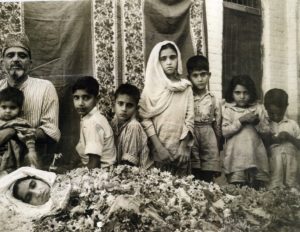
His next child is daughter Sajida Riaz is the widow of Riaz Ahmed Ghumman who was the Manager in ShahNwaz Ltd in Pakistan. They have raised five daughters. Two are MBBS themselves married to two MDs. One is a pharmacist married to a dentist. One is a computer wizard. And one has already raised an MD physician.
His youngest son Majid Ali M.B.B.S., F,R.C.S., M,D., has been the Afsar Jalsa Salana of the Ahmadiyya Community in USA, President of the Holy Name Hospital in New Jersey, Professor in American Universities and the Host Radio Shows. He lives with his wife Talat Ali in New York His first son is an MD physician married to a physician, second son a CPA and the daughter married to a corporate officer.
His next child is the daughter Quanita Begum, M.A., who has played an important role for nearly four decades serving the Community. She is the wife of Ahsanullah Zafar, M.B.B.S., M.D., who served the Ahmadiyya Community in various capacities including the President Willingboro, NJ, Naib Amir USA, and then topped as the Amir Jamaat USA for many years. They live in New Jersey. Both their daughters are MD physicians. Their only son was an MD physician married to a lawyer wife but unfortunately both died together in an auto crash.
His youngest daughter Khalda Zafar, M.A (Statistics) retired as a Professor in the Punjab University. She is the wife of Sameullah Zafar, LL.B (Punjab), LL.M (Eng), LL.M (Harvard) who has been a Professor in the Punjab University Law College and is a practicing Attorney in Lahore. They live in Lahore, Pakistan. They have three children who all are Attorneys.
I am not bragging on our account, but stating only some of the above details because Abba Ji Chaudhry Azam Ali was an ordinary man who performed extraordinary feats after he became an Ahmadi, lived as an Ahmadi, was known as an Ahmadi, and was an excellent fruit of the tree of Ahmadiyyat.
Page 14
He considered himself sent to serve the humanity in many parts of the world.
He served tens of thousands as a fair and just Judge dispensing true justice.
He served hundreds of people by inviting them to the Truth, real Islam and Ahmadiyyat.
He served at least a couple of hundred persons to become practicing Ahmadi.
He served seven of his children with marvelous spirituality, excellent education, good health and solid productive working habits.
He is a living, lighted and illustrious example of the acceptance of the prayer of the Promised Messiah, peace on him, who prayed for his physical and spiritual children as follows.
Men of dignity they become; pride of community they all be
For the Truth may they give all; Friends of God they all be
Growing every generation, from one to a thousand they all be
Bless this day my God Holy. Your holy watch is all over me
He was an exemplary fulfillment of the prophetic forecast about him in the words of the Khalifa-tool-Massih II (razi-Allaho-unho) in the Annual Convention of 1933 when he addressed the entire Ahmadiyya Community and said the following.
“… Chaudhry Azam Ali Sahib who recently became an Ahmadi. He has shown an exemplary sincerity. He came from the Shiites but in a very short time has produced an excellent example of devotion. I see no reason why new entrants in the Community should not emulate him in making progress in the matters of their religion.”


Tr- Azam Ali, Ahmadi Moslem, As seen by Daughter
Azam Ali, an Ahmadi Moslem
Dad seen by daughter
by
Sajida Riaz Ahmad
Assisted by and titles by
Azra Abid Buttar
Urdu version of a part of the article was published in Un-Noor, USA of May-June 2016.
http://www.ahmadiyyagazette.us/Source/2016/May-Jun/May_Jun2016-UrduSection.pdf
Ancestors
My father Mokarrum Chaudhry Azam Ali was born in 1902 to Mokarrum Chaudhry Rehmat Ali Sahib in the village Kirto of District Sheikhupurah. Originally called Kartarporah the village is around fifty miles in northwest of Lahore. Later it became known as Kirto. The Satellite view of the village now shows it written as Kirto Sharif.
At one time the lands around the village belonged to our 7th great-grandfather Kartar Singh. He had defeated a royal wrestler at the time the Moguls ruled India. He was awarded the prize to ride his buffalo and own all the land that the buffalo covered in one day. That is how he came to own seven villages. The site he settled on got named after him as Kartarporah and the twin-villages were called Kirto-Pandori because his brother Pandora Singh also lived there
Our grandfather Chaudhry Rehmat Ali was a Shiite who had an Imam Bara, owned horses and practiced congregational mourning and other rituals with total dedication. Our grandmother passed away when our father was about 20 years old. The mother of our father and the mother of Sir Zafrullah Khan who later became a Judge in the International Court of Justice at the Hague were cousins being the daughters of two sisters.
Abba received his primary education in the village, attended high school in Gujranwala, and graduated from the Deyal Singh College, Lahore. A merit-based scholarship enabled him to continue studies further. He obtained an LL.B. degree from Law College Lahore and later passed the PCS (Punjab Civil Service) examination.
Entry into Ahmadiyyat
Abba Ji did not like some Shiite rituals. He studied religious materials on his own. By grace of God he came across Ahmadiyya literature and read it. The more he read it the more he was drawn towards Ahmadiyyat. He prayed to the Almighty God to show him the right road. He reached an absolute conviction and became Ahmadi in1930. He devoted his life to serve the Ahmadiyyat. He bequeathed one-third in Wasiyyut (dedication of one’s assets for the service of the Ahmadiyyat).
Our grandfather vehemently opposed our father’s becoming an Ahmadi and even disentitled him from all inheritance. The discontinuation of funding for a student can become a problem but the Almighty God always takes care of His beloved people.
Abba Ji took seriously his duty to spread the message of real Islam, the Ahmadiyyat. He explained things well to his relatives and others in the village where his father and brothers had once led the opposition. By the grace of God and the prayers of the Khalifa-tool-Massih (razi-Allaho-unho), his continued efforts with wise ways [per the Holy Qor-aan 016:126] started producing positive changes. Eventually his father embraced Ahmadiyyyat. Gradually many others in the village followed him and became Ahmadi.
Page 1
Words of the Khalifa-tool-Massih II (razi-Allaho-unho)
His devotional growth was certified by the glorious tribute that the Khalifa-tool-Massih II (razi-Allaho-unho) paid in his Annual Conference Speech in 1933. I reproduce an extract about two persons who coincidently later became related as the father-in-law and son-in-law.
“By the Grace of God a new spirit is growing in Punjab. It seemed practically dead for a time but a new growth is in the offing for the last two years. By the Grace of God young men with quality and devotion are coming forward.
“Today I will mention the names of some of them. This conforms to the tradition set by the Promised Messiah (Aalai-hissalaam) who used to announce the names of some devotees. Taking the names this way generates in them a self-esteem to keep their names good. There is also a need to name some devout young men in order to highlight their efforts and accentuate their abilities to work.
“One of them is Chaudhry Faqir Mohammed Sahib who has been Ahmadi for some time and is an excellent example for young men.
Another is Chaudhry Azam Ali Sahib who recently became an Ahmadi. He has shown an exemplary sincerity. He came from the Shiites but in a very short time has produced an excellent example of devotion. I see no reason why new entrants in the Community should not emulate him in making progress in the matters of their religion. Six months after his Bai-ut (initiation in the Community) when I saw him I could not recognize him because his facial expression showed a piety as if he had been an Ahmadi for a long time.” [History of Ahmadiyyat, Vol 6, pp 132, 133]
Testimony of a fellow devout
Such extraordinary appreciation must surely have been preceded by untiring hard work in spreading the word. We have no saved record of those feats but one can imagine that from a writing of Mokarrum Mian Abdur Raheem Deyanut Durwaish (a devotee who voluntarily stayed behind to protect the Ahmadi town of) Qadian who wrote as follows.
“This happened in Makarian,. Chaudhry Azam Ali Judge came there on a Waqf-e-Aarzi (Voluntarily but temporarily undertaken obligation earmarked to spread the word of God).
One day in his own unique way he stopped a Moslem on the road and extended the ‘Call to God.’ While talking he said that the religious scholars of our time have not acted honestly. So much so that even the wolf who (was accused that it) ate Hudzrut Joseph (peace on him) said to Hudzrut Jacob (peace on him) that “If I ate Joseph, may I resurrect as a 14th Century scholar.”
Page 2
“The addressee demanded to know where it was written. Chaudhry Sahib brought him home. He looked in the book and found that excerpt missing. Chaudhry Sahib did not know that religious scholars did such a thing and mutilated books by deleting the entire episodes from there.
“Chaudhry Sahib was a simple man, very sincere. I saw blisters on his feet from long walks but he never missed a day of preaching. We benefitted a great deal from Chaudhry Sahib’s personal grandeur and righteousness demeaners. People came to him for consultations.
I had developed an expertise in cooking. Chaudhry Sahib utilized that to invite high officials and people in the upper echelon. That provided an opportunity to start conversation and a facilitated our living a better life in the area. The Almighty God does indeed put His people to good use. May God reward him with the best possible rewards; Amen [The Living Tree by Amatul Bari Nasir, p 135]
Marriages
Chaudhry Azam Ali was still studying in the Law College when according to the custom and Elders’ decision he was married to Mokuramah Amina Begum, daughter of Chaudhry Sultan Ahmad, Bar at Law. She was a sister of the famous poet Faiz Ahmad Faiz. We called her Amma Ji. Amma Ji was of a simple nature and highly religious bent of mind. She was determined to memorize the Holy Qor-aan. Her life revolved around that. Uninterested in worldly attractions she remained engrossed in praying all the time. She gave birth to two daughters and one son.
My father was a Sessions Judge who also served the Community in many notable positions. He was highly interested in preaching. It was necessary to have a life companion from an Ahmadi home and well-versed in religious affairs. At the suggestion of Khalifa-tool-Massih II (razi-Allaho-unho) my father got married for a second time to Mokuramah Sakina Begum Sahiba, daughter of Chaudhry Faqir Mohammad who was a Deputy Superintendent Police.
My mother’s age at the time of her marriage was thirteen-and-a-half years. She was a student in 7th grade and a class-fellow of Syyedah Maryam Siddiqah (razi-Allaho-unhaa) and Sahibzadi Amatur Rasheed Sahiba. Being of a tender age and being sent as a second wife, her mother had reservations to this marriage. But upon hearing that the move for the marriage had been initiated by the then-Khalifa, her father also conceded.
Relations with the family of the Promised Messiah, alaihissalaam.
My maternal grandfather’s house Faqir Manzil was located on Railway Road in Qadian. Our maternal grandmother was a simple strong-willed Jutti who kept two or three buffaloes at home and had always a lot of milk, yogurt and butter at hand. She often recalled how Hudzrut Amma Jan (razi-Allaho-unhaa) on her morning walks came to our home and had breakfast with us. My grandmother cooked delicious Parathas (a multi-layered pita-bread laced with butter in every layer and baked) which she happily served to Hudhrut Amma Jan (razi-Allaho-unhaa).
Page 3
We had close relationships of love and respect with the whole family of the Khalifa-tool-Massih II (razi-Allaho-unho), specially with the families of Doctor Mir Mohammad Ismaeel (razi-Allaho-unho) and Mian Muzaffar Ahmad.
At times Dr Mir Mohammad Ismaeel, Mian Muzaffar Ahmad, my maternal grandfather and my father as government officers were posted in the same city. That provided these Ahmadi devout ample opportunities to meet and enabled their families interact and admire each other.
Loss of our mother
Our mother was blessed by the Almighty God with four sons and three daughters. Born in 1919 and died in 1948, she had a very short life and spent only fifteen years with Abba Ji.
We lived in Campbellpore. My mother was Moosiyyah (a woman who had dedicated a part of her assets for the service of the Ahmadiyyat). Immediately transporting her body to Rabwah was difficult; so she was buried in Campbellpore in-trust. The following year she was brought to and laid rest in the Bahishti Maaqbarah in the grounds of Rabwah.
This writer at that time was a 10-year old and our youngest sister was 10-months old. My aunt who was the mother of Dr Ahsanullah Zafar, the Amir of the Ahmadiyya Community in USA, used to keep me with her. All us siblings remained very close to our maternal grandmother.
Character
A great responsibility had fallen on our father. Amma Ji despite being busy in memorizing the Holy Qor-aan and otherwise a very silent person was nevertheless the lady of the house. But even she died 12/13 years after my mother’s death. Then on my father was left alone for the uphill task of taking care of all 10 of his children. Some people suggested that Abba Ji marry again but he disagreed. Instead of pushing the kids into a turmoil, he sacrificed himself and passed a difficult life.
The job of a Sessions Judge was pretty difficult and time-consuming. But Abba Ji all alone with the God-given rare abilities fended for his children, provided the worldly and religious education, arranged their marriages and filled every heavy-duty responsibility in an unparalleled excellence for about 30 years
He was very keen on providing religious coaching.
He employed Haafiz to teach his children the Holy Qor-aan as experts in teaching that.
He taught the translation and extrapolation of the Holy Qor-aan himself.
He bought a copy for every one of his children when Tufseer-e-Sagheer was published
He heard from us children the prayers and theirs translations.
Page 4
He lead the prayers at home when he was there and conducted discussions afterwards.
He discussed some of his cases and shared conclusions how bad actions entail bad results.
He narrated incidents from the Islamic History in order to train us as hard core Moslems.
He fixed prizes for reading pages of books by the Promised Messiah (Alai-hissalam). He intended that way to develop in us children a taste to study those books.
He supplied solutions to our problems often in a question-answer format.
He took us to attend the Friday prayers along with him.
He regularly brought us to Rabwah to attend the Annual Conventions.
He bought six kanals of land in Rabwah and built a house on four kanals.
He wanted his children to get good education by living in the Center.
He prayed and prayed and worked hard to raise his children educated dedicated Ahmadi.
He got rewarded by the grace of Allah to have all his children grow up highly educated.
He shared his children successes including their rendering various services as Ahmadies.
He enjoyed his family’s pleasures and bore their tests and turmoil with patience.
Profession
Abba Ji served as a Judge who was a just jurist. After reaching his age of superannuation he practiced law in the Pakistan Supreme Court and Lahore High Court as a member of the High Court Bar Association. His soul was untiring and his mind never ceased working to the optimum.
During his service he probed deeply every case that came to his court. Difficult cases were entrusted to him when connections and money were suspected to illegally influence the outcome of a case and an iron-fisted fair and just adjudication was required. He received threats to his life and even actual attacks — but he never budged from the truth and justice.
Professional services to people he rendered as the worship of the Almighty God.
Prayers, persistence, honesty and hard work were his way of life.
Prior reputation as an unapproachable judge ran ahead of him wherever his was posted.
Practicing the culture of Ahmadiyyat diligently, he served it wherever he went.
Promotions in his 26/27 years service career elevated him to a District and Sessions Judge.
Posting as Session Judge in home district of Sheikhupurah made him a legend in honesty.
Public recognition of his excellent work resulted in a 3-year extension in his service tenure
Performing as a just judge led to his serving higher tribunals, like a Claims Commissioner.
Pension increase and Certificate of Appreciation he received at retirement.
His class-fellows, friends and apprentices included Judges and lawyers of great caliber. Justice Munir, Justice Kayani, Justice Sardar Iqbal, Justice Malik Abdul Hameed, Justice Samdani, Justice Shafi-ur-Rehman and many others vouched for his capabilities. Ahmadi Sessions Judges like Chadhry Bashir Ahmad, Chadhry Aziz Ahmad Bajwa and Mahr Sher Mohammad Sial were his friends who greatly admired and genuinely held him in a high esteem.
Page 5
In 1950, Justice Sharif Ahmad wrote that he could revolutionize the Pakistan Judiciary if he could find a few honest judges like Chaudhry Azam Ali. In 1985, Justice Samdani entrusted with an inquiry relative to Ahmadiyya Community went out of the way to seek the help from Abba Ji and Chaudhry Aziz Ahmad Bajwa because he personally knew that these two gentlemen would always side, support and stay with the truth.
Sacrifices
Only his passion for preaching exceeded his giving charity. He helped his villagers any way he could. He gave in all appeals for money but earned only by lawful means. He was a rare breed of just, honest and fair judges who remained far above the rampant opportunities of illicit gains that plagued Government Services. As a daughter I can vouch that he never touched even a single penny from any illegal conduct.
He donated in different charities on behalf of all his family members. He was a One-third Moosi (who bequeath part of their assets for the service of the Community). He enrolled his mother and all members of his family in the ‘First-Rank of 5000-Strivers of Tehrik-e-Jadeed’ and regularly contributed on their behalf as reflected in records as follows.
03697 Chaudhry Azam Ali
03703 Hamid Ali son of Chaudhry Azam Ali
03702 Imtiaz Ali son of Chaudhry Azam Ali
03701 Qunita Begum daughter of Chaudhry Azam Ali
3698A Mother of Chaudhry Azam Ali
03704 Majid Ali son of Chaudhry Azam Ali
03706 Mohammad Sadiq son of Chaudhry Azam Ali
03707 Abid Ali son of Chaudhry Azam Ali
03699 Rasheeda Begum daughter of Chaudhry Azam Ali
03700 Sajida Begum daughter of Chaudhry Azam Ali
03705 Sakina Begum wife of Chaudhry Azam Ali
He was a Devotee For Life who dedicated all his sons as the Devotees as well. His top priority was serving the Community. In his job he was transferred to big cities. Wherever he went, he contacted the Community promptly and was entrusted with rendering important services.
Preaching in a village
His interest in preaching exceeded all limits. He was a preacher at heart. Several times each month he went out to the nearby villages in simple dress and appearance. He knew Punjabi-speaking villagers’ response to the news of the arrival of the Messiah-Of-The-Time.
Some of those events left behind extraordinarily lasting memories. He was posted in Zeera which is a town in the Eastern Punjab. He chose to utilize a holiday for his usual preaching
Page 6
activity and decided to go out and deliver the message about his beloved, the Messiah.
Abba Ji reached a village at the time of severe heat of harvesting the wheat. He took a scythe, mixed with the laborers and started cutting crop and conveying the news of the arrival of Messiah.
Customarily a farmer sought his wheat out of the fields fast at harvesting time. Cutting crop under bright hot summer sun was not an easy task. Many laborers never returned to work on the day after they had received their wage. To ensure the labor’s return next day the farmers paid only after a crop had been fully harvested.
Abba Ji worked shoulder to shoulder with the laborers all day in the blistering heat. In the evening the laborers complained to their farmer: “This man has picked our brains all day. He talked of things above our heads. Please pay him his wage and send him away so that he doesn’t have to turn up next day.”
The farmer looked at the appearance of Abba Ji and said nothing. He tried paying him higher wage based upon his best performance of the day and to ensure his return next day, but Abba Ji got up, dusted off his clothes and walked away.
A policeman happened to pass by. In surprise he asked him, “Judge Sahib, what brought you here.” Abba Ji replied that he had come to fill his wish.
Calling all around is only our real task today.
The good natured will come after all one day.
[The Promised Messiah, peace on him]
The farmer came to know that the person from who took labor all day and fed like laborers was the Judge in Zeerah. So next day he came to our father’s Court to apologize. Abba Ji treated the farmer with great respect and assured him that he had done all that of his own free will.
Preaching in the villages
Whenever he visited his native village he went to the nearby villages. Villages have old feuds and murders. That is why fearlessly going in another’s territory was dangerous but he trusted his God, the Great Protector. Without fearing any danger he went on preaching. Besides enemy’s attacks, dangerous poisonous snakes were also common. The saline land is as much notorious for its poisonous snakes as it is famous for its Basmati rice.
Whenever he did not return home for two or three days his family members grew concerned. When our grandfather admonished him, he calmly replied that life and death were in the hands of God, “I am His man and the Almighty Allah Himself protects me.”
Page 7
Co-villagers of Abba Ji also made great progress in devotion. Our paternal uncles built a mosque. An Ahmadiyya library was also set up. When a ban was placed on Ahmadiyya ommunity from calling the Azan (for prayers), nobody dared to stop Azans from this mosque. The Khalifa-tool-Massih IV (ra-hay-mul-laaho-alaihay) mentioned this incident in one Friday sermon in appreciative tones.
Incident in the High Court Bar
In 1974 or 1975 Abba Ji was practicing in the High Court. He used to sit on a table in the Bar room. Chaudhry Aziz Ahmad Bajwa and uncle Chaudhry Abdullah Bajwa (father of Wajeeh Bajwa of USA) also took seat on that table. Once a placard written with the word Graveyard was put on their table. When these gentlemen ignored that, the opponents felt infuriated even more.
As Abba Ji got up to walk away, a young lawyer caught him by the throat while all around educated people just sat and stared. The young man was probably stricken by the fact that he was the nephew of a Justice. He screamed, “You are an Infidel. Recite the Kalima. Become a Moslem.” He also announced a reward if Abba Ji converted, “I will divorce my wife and along with my two sisters I will deliver them to you to do what you like.” [Perhaps he wanted to get rid of his wife anyway and did not want to incur the usual cost of a divorce!]
Abba Ji calmly said that he was a Moslem, recited the Kalima and added, “I am a better Moslem than you.” That man demanded to abuse Mirza Sahib. Abba Ji said, “The Holy Prophet (s.a.w) had prohibited cursing the leader of any religion. How can I abuse him whom I consider to be the Imam of our Time.”
That young lawyer roiling in anger continued threatening. Abba Ji had just one reply, “My life is in the hands of the Omnipotent Omnipresent, the Master who has never left me.” The well-wishers advised Abba Ji to seek legal recourse against that out and out transgressor but Abba Ji kept quiet and left the matter to God.
A funny anecdote followed. Those days I was visiting Abba Ji in Lahore. Mullahs in Daska had made our lives difficult. So my husband Riaz and our five daughters had come to Lahore. We were staying on Edwards Road in a flat above the office of my brother Abid Buttar who was an Advocate in the High Court. Abba Ji came and told us of the whole incident. Riaz in his usual manner and masterful ability to turn even the most sad or painful thing into a laughable joke commented that Abba Ji should have let those women come — and serve us as our servants. Abba Ji just kept asking for God’s Forgiveness and repeating ‘We belong to Allah and to Him we will return‘ [per The Holy Qor-aan 002:157].
The matter had not really ended there. Around midnight Abba Ji noticed some people jump over our gate and the outer wall. They were about fifty armed with daggers, knives and sticks. Riaz, I and our daughters sat by a window in a room upstairs. Abba Ji gave Riaz his pistol
Page 8
and told him to fire only if the raiders broke open the office door. Then he took his rifle, sat by the window in the office downstairs, called a cousin Irfan Ali and apprised him of the situation.
Behind our office in the Old Anarkali area were homes of some Hulwaaees, the merchants who sold sweets. They were also wrestlers. They held Abba Ji in high esteem, having had some cases in the High Court and guidance from Abba Ji that saved them time and money. They came out with sticks.
By then the Deputy Inspector General Police also arrived with four or five trucks loaded with policemen. Allah the Exalted thus foiled what the mischief-mongers had intended.
Visiting prisons
In 1975 Abba Ji came to USA to meet his son Dr Majid Ali and son-in-law Dr Ahsanullah Zafar. The children worked all day but Abba Ji could not sit idle. So he created a job for himself of his own liking.
He told my brother to drop him at a jail on his way to his work. Abba Ji had a life-long experience of officially inspecting jails. He knew that the prisoners had a lot of time and a state of mind that adheres to good advice; so why not to give them the message of Truth.
So my brother started to leave Abba Ji at the local prison gate. This dedication came to fruition. Some of the prisoners after coming out of the prisons became Ahmadi, came to Rabwah, sat before the then-Khaleefah and even attended the Annual Conference.
Which roads can I take to access the house You have.
What service can I render to reach my fate You have.
Interesting Stories
Abba Ji told us interesting stories. In Kirto a man came playing the role of a far-sighted saint came and held the hand of our grandfather to tell him his fortune. People sat around very impressed but our grandfather knew such imposters well. Our grandfather struck him a couple of times and said, “Maulvi, you could not see your own future that you were about to get a shoe-beating here. What could you tell me of my future.”
Sir Zafrullah Khan was a Judge in the International Court of Justice at the Hague. He was an older cousin of Abba Ji who a few years later became a fellow-lawyer and good friends. One winter he came to Pakistan for the annual Convention that enabled the two to visit with each other. Muffled in warm long overcoats they walked together for a while. They tried to keep their hands inside the pockets of their long coats. They thought they were fighting the cold by clinging to each other when Sir Zafrullah Khan asked Abba Ji to walk a bit of distance between them.
Page 9
Abba Ji said that he would like to put more distance in-between but there was a difficulty. Surprised he asked about the difficulty. Abba Ji said, “Your hand is in my pocket.” He pulled his hand out and the two had a good laugh.
In Rabwah Abba Ji used to go out to the nearby villages for preaching with a few friends like Chaudhry Fateh Mohammad Sial, Chaudhry Mohammad Hussain and Dr Ghulam Mustafa. Once they planned to walk towards Ahmad Nagar next morning. Early morning they knocked at the door of Chaudhry Fateh Mohammad Sial who hurriedly dressed himself and came out. After walking a while he realized that the Salwar (pant) he had put on was made of Satin, belonged to his wife and was too short on his long legs.
In Multan Abba Ji was posted 1949 or 1950. An influential army colonel of Montgomery / Sahiwal had some poor persons’ hutments torched in order to take possession of the land underneath. Some deaths ensued. The local judges felt uneasy to entertain the murder trial as it drew close. The case was eventually assigned to Abba Ji’s court who traveled to Montgomery and conducted the trial. The case concluded convicting all criminals – death sentence to the gang-leader colonel, life sentence to his brother and other terms to remaing four or five accomplices. The colonel on hearing the sentences threatened that – as the death of a jackal drives it to a human village – my father’s death had brought him to their town to try their case. Abba Ji prayed a lot since the motivation to hurt him was great due to the outcome of the case, his daughters attending schools and colleges and the ever-present danger on his being an Ahmadi. As always the Almighty Allah took care of him. The government posted police guards and the colonel’s gang could not harm us.
In Dera Ghazi Khan Abba Ji was the District and Session Judge. A crowd raising slogans came to raid our house. The crowd pushed ahead of it two dogs on leashes with placards around their necks, one with the name of Abba Ji and the other with that of Sir Zafrullah Khan. They were letting out their meanness by striking the dogs and abusing the notable Ahmadies. Help from the Almighty God came fast. The next door residence was of the Deputy Commissioner who had been impressed with Abba Ji’s simple lifestyle and the judicial acumen. He summoned the police who ran the crowd off before they could inflict any harm on us.
Hajj, the Pilgrimage
Abba Ji had been fortunate to perform Omrah twice. But his desire to perform the Hajj had not been filled. In 1969 he developed a great desire to do Hajj. The procedure to go for Hajj from Pakistan entailed applying many months before the Hajj, drawing of lots, and then being allowed to travel if the name had come out in the lots. Abba Ji had neither applied for the Hajj nor had the needed money but he had the desire and he prayed earnestly. In a dream he saw the Khalifa-tool-Massih I (razi-Allaho-unho) give him the good news of the Hajj although it appeared unlikely that he could go since very little time was left.
Page 10
One day a letter from my brother Dr Majid Ali in USA arrived with the details of a paid ticket and hotel bookings. Abba Ji came to us in Karachi with the ticket. We were worried that even if he could go, how would he, in weak health and used to simple ways, be able coup with the journey and live and eat in hotels.
His staying for the Hajj for the shortest possible time was deemed best. My older sister’s brother-in-law is Kanwar Idrees, CSP who also served as Pakistan’s Finance Minister. He arranged for Abba Ji such seats that he could go on the last flight before the Hajj and return by the first flight after the Hujj.
A Hajji then was allowed to take only 20 Rupees. Abba Ji took 20 Rupees and his entire luggage was his 2 pairs of clothing, one sheet and one blanket. In fact to enable him to travel light I kept his blanket so that he could buy a better one in Madina.
My husband Riaz Ghumman and I took him to the Karachi Airport to see him off. We felt concerned on his travelling alone but were fortunately allowed to accompany him to the lounge and then to the plane. We seated him, tied his safety belt around him, and stayed with him until the plane got ready to fly. We saw Almighty God Himself make all arrangements for Abba Ji.
Two and one-half hours later he arrived in Jeddah. He gave the 20 rupees he had to the porter who carried his luggage and led him to his hotel. It was a night time, strange city, and he was hungry with no money. He went up the stairs in his hotel, sat down in a corner and covered himself under his sheet.
Then some people came in. One of them appeared to be their leader. They entered in a room across from where Abba Ji was sitting but soon all left except the leader. Abba Ji heard loud painful groans from the room and entered it to check. He saw the man suffering from some severe headache bout. Abba Ji pressed his head, prayed for him and ended his prayer with a dum (the seal that the marks the end of a prayer). The man soon recovered, spoke in some other language, motioned Abba Ji to stay in his room, and even sent for food for him.
In the morning the man with whom my brother had made all arrangements arrived. He took Abba Ji to the bank and had him checked-in the hotel. Abba Ji was about to sit for breakfast when he noticed the aforesaid leader sitting on the next table. The man saw Abba Ji and invited him to his table. He saw in Abba Ji’s hand his copy of the Holy Qor-aan and in English asked if he also knew what was in that book.
Abba Ji spontaneously replied that he could take a test. He got reasonable answers to all his questions. Then he said to his companions that the simple looking man really was some kind of a big Waleeoollah (Friend of Allah). Then he told them of the prior night’s episode and respectfully extended his hand of friendship. He invited Abba Ji to his country in Africa.
Before leaving for the Hajj we had impressed upon Abba Ji to avoid talking of Ahmadiyyat during the Hajj as that could create complications. But in his simplicity Abba Ji told
Page 11
that leader that before offering friendship he should know that by God’s grace Abba Ji was an Ahmadi in allegiance to the Imam of this age. On hearing more he asked Abba Ji to visit his country in Africa and talk to his people about the Ahmadiyyat. Abba Ji could not go to Africa due to his weak health but sent him literature instead.
This is the story of a man who put his trust in only Allah. He received every convenience for his Hajj and also pursuant to his life-mission he delivered there the message of Ahmadiyyat.
While still in Makkah after the Hajj he prayed to learn if his Hajj and prayers had been accepted. Through a Saint he found that his Hajj and all prayers had been accepted.
Prayers
Before going Abba Ji had asked me what prayer he should offer for me during the Hajj. I had three daughters at that time. I asked that Allah give me a son and affluence that would not make us neglect Him. He prayed a lot and received the good news but I got two more daughters.
Once Mithaee (sweets) came from a preacher celebrating the birth of a son he had wanted for long and had Abba Ji pray for him. I had just returned from our annual Convention where women had sympathized that I had five daughters. I was quite upset. Seeing the Mithaee made me complain. God forgive me that I felt sorry and made Abba Ji sorry. He made me understand that prayers never go waste, God has the power to give a son too, and that in giving the daughters He had sent down His blessings: “Thank God. Be very thankful.” The advice and the manner in which he gave it became a part and parcel of me.
The Almighty God showed me how great blessings the daughters are All are highly capable. All are obedient. Seeing their successes I thank God every moment of the day. May Allah bless them even more — both in spiritual and temporal arenas; Amen.
Waleeoollah
Abba Ji believed in prayers. People in Pakistan and USA have told us how they asked him for prayers which were accepted and resulted in their wants filled. Chaudhry Aziz Ahmad Bajwa after retiring from his Judgeship and practicing law used to say that Abba Ji was a walking talking Waleeoollah and urged him to just pray for him so that whatever earned could be evenly split up.
Many of his dreams were filled as seen though some of his prayers and dreams took years to come to fruition. After all he was a human and delays and interpretive errors are bound to occur
Uncles Faiz Ahmad Faiz,Tofail Ahmad and Inayut Ahmad believed in Abba Ji’s prayers and believed Ahmadiyyat true though they never became Ahmadi.
Page 12
He was approached by the parents of a small girl for prayers when doctors sent her home as non-recoverable and to die in a day or two. He asked the parents to recognize Ahmadiyyat true if the child recovered. He prayed and she recovered. She lived up to be a grandmother.
He was in his village and people complained of a serious drought. He took them out and under the blazing sun led the Istisqaa (seeking water) prayer. As they prayed, a cloud rose and sprinkled a good shower on them. No wonder many villagers became Ahmadi.
He dreamt his nephew named Lateef fall from a horse and break his back. He wrote to his father to give Sadqa (charity). Some 10 days later he learnt that his own son, my oldest brother, had fallen from a horizontal bar while exercising 10 days earlier, broken his back and the Mayo Hospital had put him a plaster jacket from neck down to below-hips for three months.
He dreamt of Zuliqar Bhutto (then the powerful Prime Minister of Pakistan) dying a dog’s death. Bhutto was convicted for murder and executed many years later, after Abba Ji’s transition.
He dreamt one of his sons was translating the Holy Qor-aan. Some 25 years after his transition an English translation was started. As of today over 10% or 900 verses are translated. He dreamt his son Hamid sit on Sir Zafrullah Khan’s chair; who knows how it will get filled.
Last few days
Abba Ji spent the last few years of his life with me. My husband Riaz Ahmad Ghumman rendered great service. My brother Hamid and his wife Naseerah also got the opportunity to serve. He was admitted in the Lahore Central Hosptal where I was lucky to spend some time with him.
Abba Ji learnt nearly 2 years before his transition by a dream or vision that he would pass away a November 29 that would also be the 22nd of Moharram of Islamic calendar. On 22nd November he asked, “What is date today” and I told him. He started counting forward but stopped at 28th and said that’s it. Then he counted the dates of Moharram and at 10th he stopped and again said that’s it. These were the last dates he counted.
He passed away on November 29, 1980. Inna Lillahay Wa Inna Alaihay Rajeoon. He was a Moosi and was buried in Bahishti Maqbarah Rabwah. We pray that the Almighty God forgive him and raise his ranks and enable his progeny to walk on his footsteps. Amen
Progeny
A tree is recognized by its fruits. The tree of Abba Ji produced the following fruits. He led a life that merits to be remembered pursuant to وَاَمَّا بِنِعۡمَةِ رَبِّكَ فَحَدِّثۡ [Wa-um-maa-bay-nae-ma-tay-rub-bay-ka-fa-hud-dith = And as far the blessings of your God, so you talk about it} [The Holy Qor-aan 093:012]. Of his ten children, seven are living – all grandparents and all retired.
Page 13
His oldest child daughter Rashida Begum, M.A (Geo) is the wife of Mansoor Krishan Bajwa who retired as a Major in Pakistan Army. They live in Lahore and have a daughter wife of an Army Major, one son MBBS, MD and President of Ahmadiyya Jamaat Harrisburg, 2nd son a Ph.D. Professor, 3rd son a leader Banker in Pakistan and youngest daughter in Canada.
His oldest son Abid A Buttar, M.A (Arabic), LL.B, has been an Attorney in Pakistan and USA. He has served the Community for many years in various positions including the Quaid Khooddam-ul-Ahmadiyya Lahore, President Ahmadiyya Inter-Collegiate Association, Secretary Ahmadiyya Lawyers Association Pakistan, Ansarullh and the Community in USA in may positions. He lives with his wife Azra A Buttar in St Louis, Mo. They have four children – a doctor, two attorneys and a businessman – each a power magnet in his or her own field and wooed all over the internet.
His middle son Hamid A Buttar has been a businessman and Mill Owner in Pakistan. He lives with his wife Naseera Begum in Vancover, Canada. They have one son B.A., LL.B, two daughters accountants, one son a businessman, and two daughters raising educated families.
His next child is daughter Sajida Riaz is the widow of Riaz Ahmed Ghumman who was the Manager in ShahNwaz Ltd in Pakistan. They have raised five daughters. Two are MBBS themselves married to two MDs. One is a pharmacist married to a dentist. One is a computer wizard. And one has already raised an MD physician.
His youngest son Majid Ali M.B.B.S., F,R.C.S., M,D., has been the Afsar Jalsa Salana of the Ahmadiyya Community in USA, President of the Holy Name Hospital in New Jersey, Professor in American Universities and the Host Radio Shows. He lives with his wife Talat Ali in New York His first son is an MD physician married to a physician, second son a CPA and the daughter married to a corporate officer.
His next child is the daughter Quanita Begum, M.A., who has played an important role for nearly four decades serving the Community. She is the wife of Ahsanullah Zafar, M.B.B.S., M.D., who served the Ahmadiyya Community in various capacities including the President Willingboro, NJ, Naib Amir USA, and then topped as the Amir Jamaat USA for many years. They live in New Jersey. Both their daughters are MD physicians. Their only son was an MD physician married to a lawyer wife but unfortunately both died together in an auto crash.
His youngest daughter Khalda Zafar, M.A (Statistics) retired as a Professor in the Punjab University. She is the wife of Sameullah Zafar, LL.B (Punjab), LL.M (Eng), LL.M (Harvard) who has been a Professor in the Punjab University Law College and is a practicing Attorney in Lahore. They live in Lahore, Pakistan. They have three children who all are Attorneys.
I am not bragging on our account, but stating only some of the above details because Abba Ji Chaudhry Azam Ali was an ordinary man who performed extraordinary feats after he became an Ahmadi, lived as an Ahmadi, was known as an Ahmadi, and was an excellent fruit of the tree of Ahmadiyyat.
Page 14
He considered himself sent to serve the humanity in many parts of the world.
He served tens of thousands as a fair and just Judge dispensing true justice.
He served hundreds of people by inviting them to the Truth, real Islam and Ahmadiyyat.
He served at least a couple of hundred persons to become practicing Ahmadi.
He served seven of his children with marvelous spirituality, excellent education, good health and solid productive working habits.
He is a living, lighted and illustrious example of the acceptance of the prayer of the Promised Messiah, peace on him, who prayed for his physical and spiritual children as follows.
Men of dignity they become; pride of community they all be
For the Truth may they give all; Friends of God they all be
Growing every generation, from one to a thousand they all be
Bless this day my God Holy. Your holy watch is all over me
He was an exemplary fulfillment of the prophetic forecast about him in the words of the Khalifa-tool-Massih II (razi-Allaho-unho) in the Annual Convention of 1933 when he addressed the entire Ahmadiyya Community and said the following.
“… Chaudhry Azam Ali Sahib who recently became an Ahmadi. He has shown an exemplary sincerity. He came from the Shiites but in a very short time has produced an excellent example of devotion. I see no reason why new entrants in the Community should not emulate him in making progress in the matters of their religion.”